FXFOWLE Installation
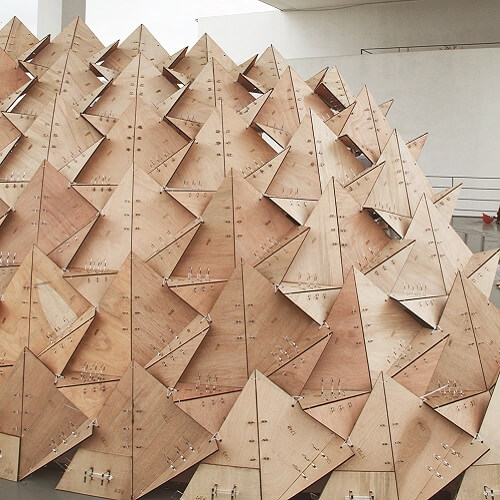
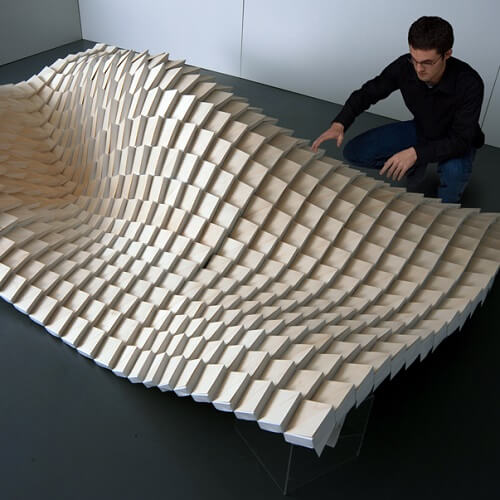
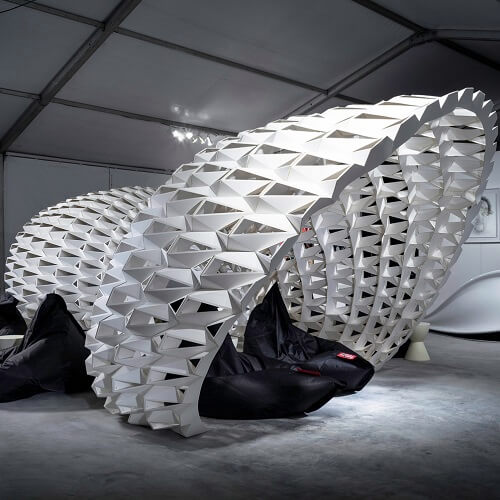
FXFOWLE Lounge by FXFOWLE Architects, features a free-standing architectural pavilion. The pavilion which pairs technologically-sophisticated scripting software with simple museum board, comprises 180 varying segments.
The F2 Pavilion was designed and fabricated by University of Texas San Antonio (UTSA) College of Architecture’s graduate students under the direction of Andrew Kudless, Director of Matsys.
Designer Julia Ibbini is interested in human and machine collaboration in a traverse of analog and digital to create work with highly detailed machined precision, but which remains distinctly human in origin.
A deep facade of wooden blades, designed in a wave-shape by Project Meganom, gives the building dynamics, while remaining stable.
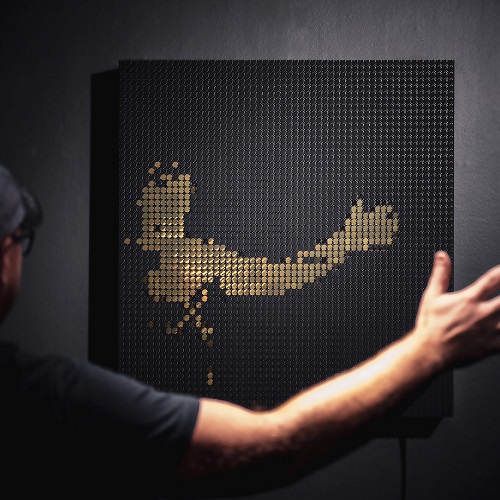
“Echo” by Breakfast is a multi-sensory experience that visualizes real-time data occurring on social media through ripples that move across the surface. As the amount of social posts changes, it will impact the clarity of your portrait.
The SZU pavilion is the result of a semester long module collaborated between HKPDA and Shenzhen University. The geometry is generated through Grasshopper Plugin: kangaroo, a force simulation software.
Crysalis (III) is a sculptural piece that explores cellular morphologies using parametric tools and composite materials. Designed and built by MATSYS, the sculpture takes direct inspiration from the organization of barnacle-like cells.
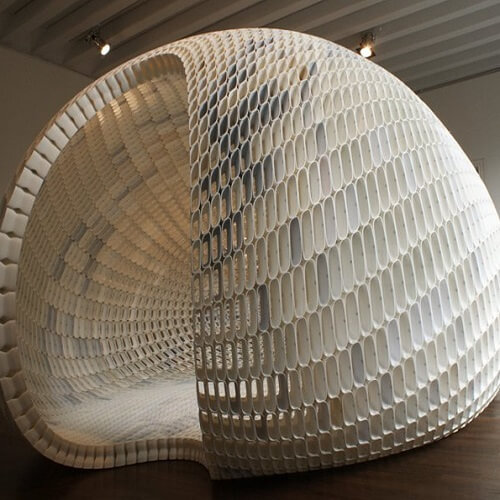
Project EGG is made from 4,760 individuated pieces, which have been made by hundreds of desktop 3D-printers from all over the world. Conceived and organized by furniture designer Michiel Van Der Kley, the irregular ellipsoid form measures roughly 5 x 4 x 3 meters.
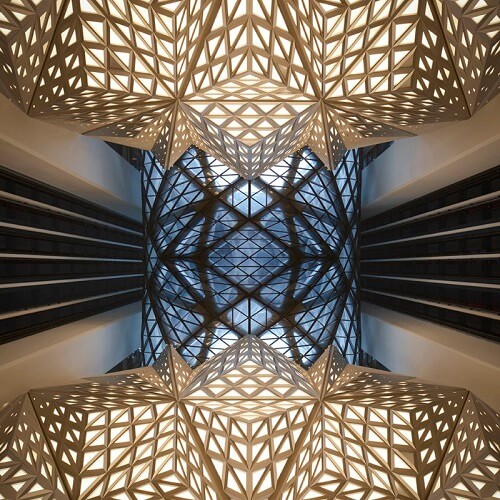
Zaha Hadid Architects has a way of designing buildings so intricate and complex that the photographs look like renderings rather than completed architecture. Their latest unveiling is Morpheus, the flagship hotel for the City of Dreams resort in Macau.
The project “Responsive Surface Structure” by Steffen Reichert is based on an experimental, inductive design approach. The project aims at creating a differentiated skin structure that can change its porosity in response to changes in ambient humidity and moisture.
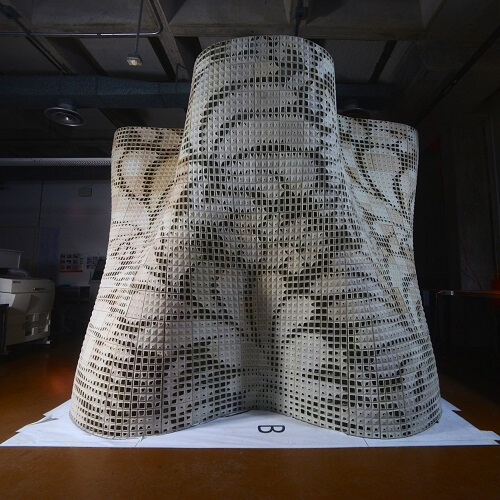
The California-based Emerging Objects team has created Bloom, a pavilion constructed from 840 unique blocks 3-D printed from portland cement. The 9-foot (2.7 meter) tall pavilion is cruciform in plan, morphing as it rises to become the same cruciform shape twisted by 45 degrees.
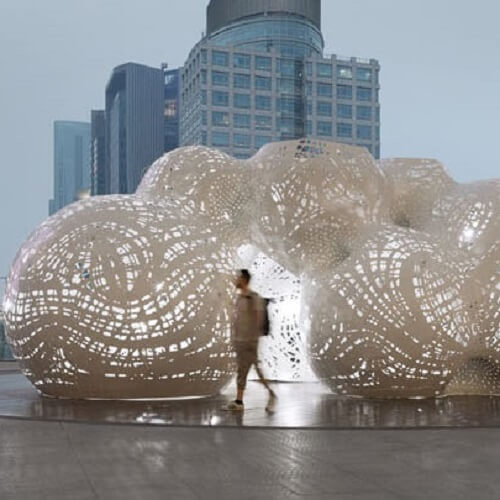
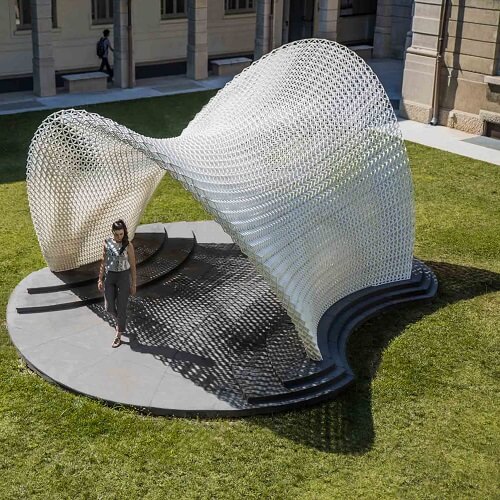
Marc Fornes / The Very Many designed a large-scale sculptural outdoor pavilion on the elevated plaza of the Suzhou Center in China, as part of the Jinji Lake Biennial. Named ‘Boolean Operator’, the installation has been crafted from white aluminum.
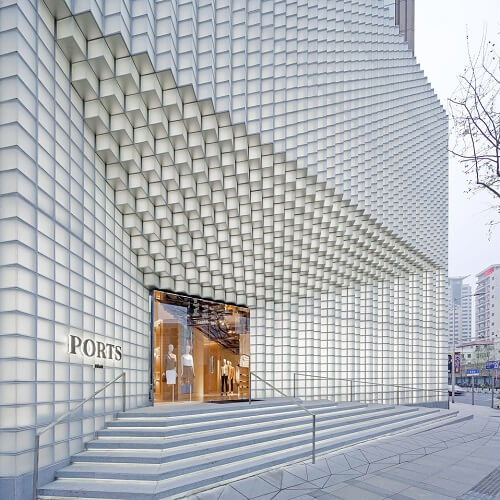
Canadian studio UUfie created a pixellated physical appearance for the facade of this Shanghai boutique by adding rows of translucent glass cubes that light up at night like a big screen. Glass blocks are organized in a meticulous gridded pattern across the walls of the constructing.
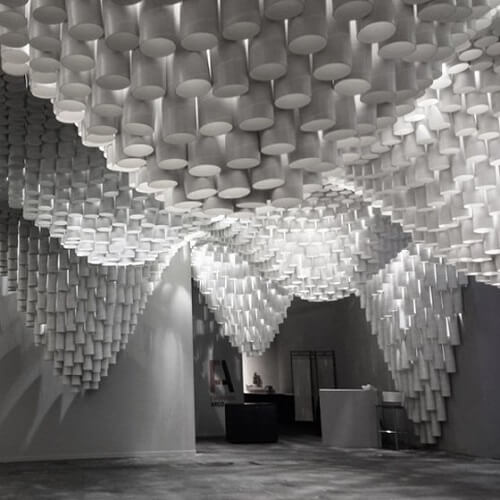
This massive, room-filling paper ‘chandelier’ designed by Cristina Parreño Architecture in cooperation with a team from MIT (James Coleman, Sharon Xu, Koharu Usui, Natthida Wiwatwicha and Hannah Ahlblad), capitalizes on surface geometry. Installed and displayed at the ARCOMadrid art fair in Spain.
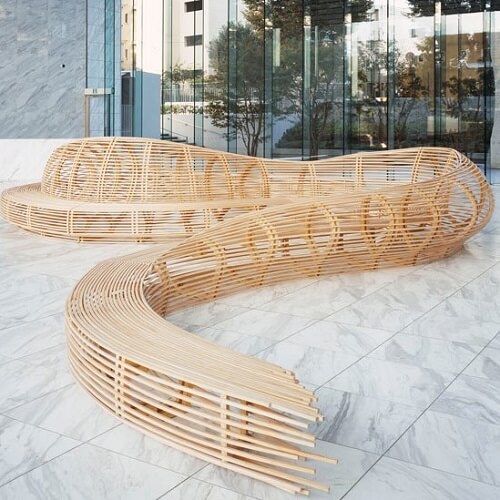
Frank Gehry (or better Craig Webb and Claire Imatani of Gehry Partners) designed the visitors bench for the world company building in Tokyo, Japan. The bench was manufactured by Tomas Osinski design inc., an architect-sculptor who long worked for Gehry.
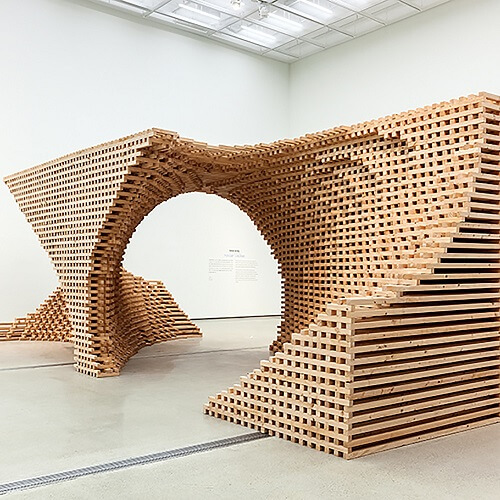
Part to Whole by HG-A | LIVE COMPONENTS is ‘space’ defined by the whole came from the flow of repetition. The set of circles moving along the curve constructs continuous void space. It digs the specific volume out of the cube, which maximizes available space and minimizes materials at the same time.
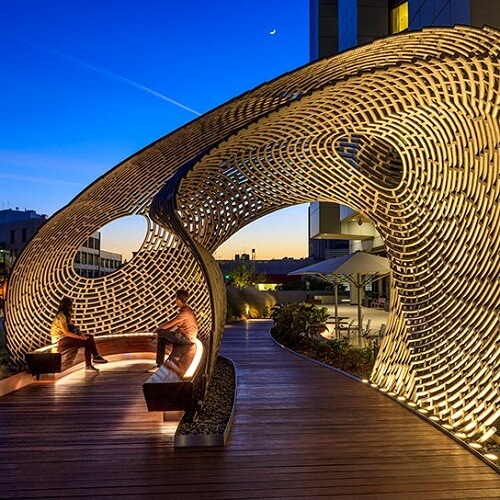
Ball-Nogues studio has completed the ‘healing pavilion’, a structure that provides shade and seating within the new garden of a Los Angeles hospital. the pavilion was created using 2,793 linear feet of 2-inch diameter mild steel tube.
Trabeculae Pavilion by WASP is a lightweight architecture completely 3D printed that fuses advancements in 3D printing with bio-inspired computational design. The synergy of design, material and manufacturing technologies allowed the conceptualization of an innovative construction technique.
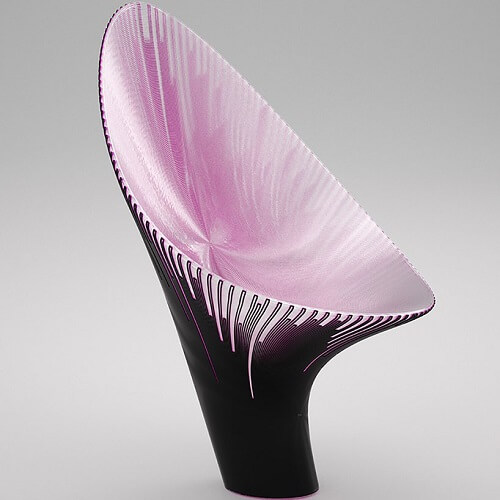
Bow is the result of Zaha Hadid architects’ extensive research with 3D printing and material experimentation. It’s biodegradable, and machine-optimized, printed with a pellet-extruder (meaning, they employ plastic particles rather than filament), and colored in such an adaptive way.
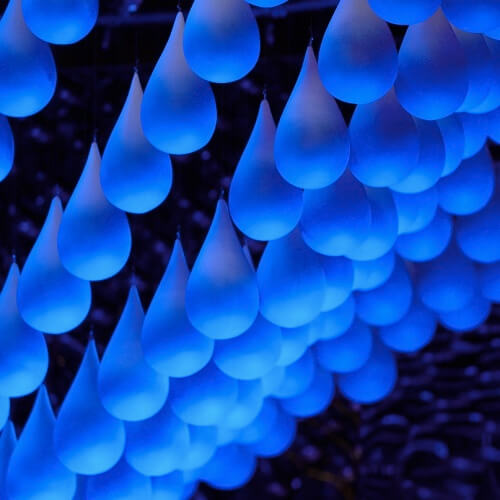
Water Ripples is a kinetic sculpture designed to celebrate the beauty and power of water, surrounding visitors in waves in response to donations made to the water access charity. It is composed of 600 handmade water droplets, controlled by custom designed motorized winches.