StarShade Origami Spacecraft

StarShade Origami Spacecraft

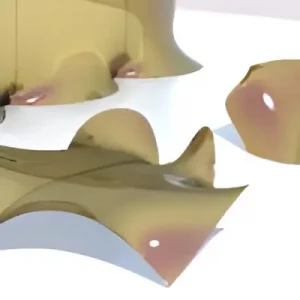
NASA is using origami to build a giant star blocker, in hopes of imaging distant worlds. “Origami, the Japanese tradition of paper-folding, has inspired a number of unique spacecraft designs. It’s little wonder that it fascinates NASA engineers: origami can seem deceptively simple, hiding complex math within its creases.”

Continue reading

Origami Structures and Examples

Origami Structures and Examples

In recent decades origami structures and forms has been of increasing interest to mathematicians and engineers. Mathematicians are more interested in the geometrical aspects of origami objects such as foldability of origami patterns, especially foldability of developable surfaces.

Continue reading

Origami Structures and Examples

Origami Structures and Examples

In recent decades origami structures and forms has been of increasing interest to mathematicians and engineers. Mathematicians are more interested in the geometrical aspects of origami objects such as foldability of origami patterns, especially foldability of developable surfaces.

Continue reading

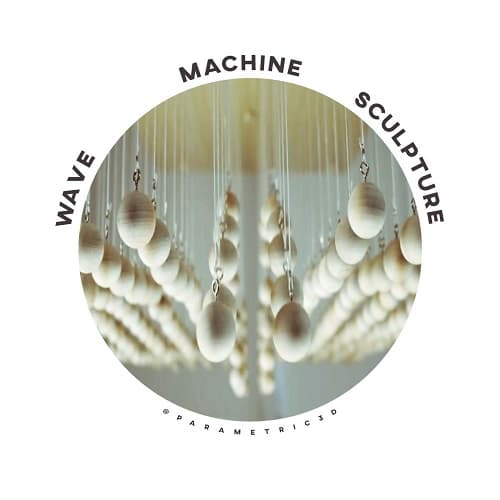
Wave Machine Sculpture

Wave Machine Sculpture

The FiberLab Symphony Orchestra, consisting of 1 perforated hardboard, 2 craft rings, 12 wooden trims, 288 wooden balls, 720 metal findings, and about 1500 feet of nylon string – all accompanied by the ravishingly beautiful String Quartet No. 2 by Alexander Borodin.

Continue reading

HypoSurface Interactive Installation

HypoSurface

The Hyposurface is comprised by a matrix of actuators, which are given positional information via a highly efficient bus system as well as an array of electronic sensors used to trigger a variety of mathematical deployment programs.

Continue reading

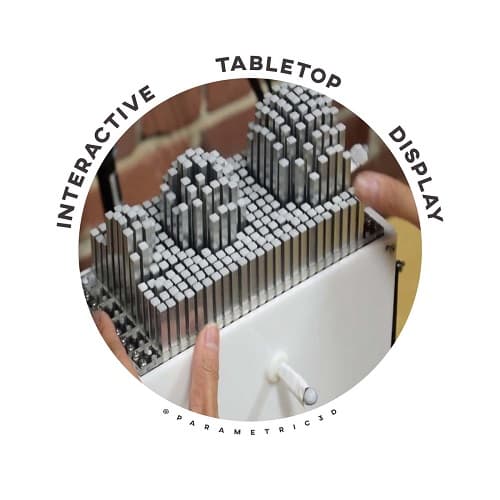
ShapeShift Interactive Tabletop Display

ShapeShift

ShapeShift is a compact, high-resolution (7 mm pitch), mobile tabletop shape display. We explore potential interaction techniques in both passive and active mobile scenarios. In the passive case, the user is able to freely move and spin the display as it renders elements.

Continue reading

Transforming Toys

Transforming Toys

Chuck Hoberman is an artist, engineer, architect, and inventor of folding toys and structures, most notably the Hoberman sphere. In addition to toys such as the Hoberman sphere, Hoberman created the BrainTwist, a hard plastic tetrahedron that folds, stellates, and becomes self-dual while having a component that rotates similarly to a Rubik’s Cube.

Continue reading

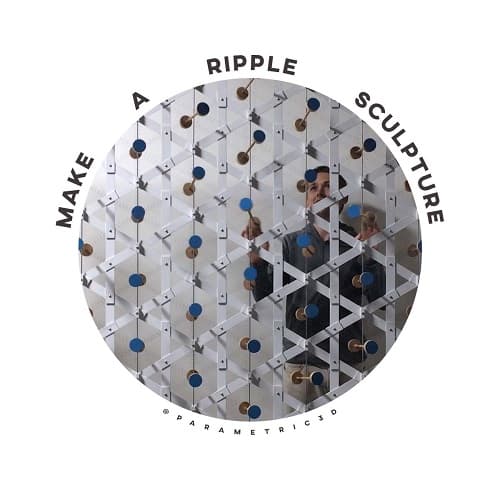
Make A Ripple kinetic sculpture

Make A Ripple

Make A Ripple (2017) is a custom kinetic sculpture. It consists of 60 moving elements that are interconnected with springs. The elements are counterbalanced rods with disks on the ends which can pivot freely on a kind of universal joint.

Continue reading

Transforming Toys

Transforming Toys

Chuck Hoberman is an artist, engineer, architect, and inventor of folding toys and structures, most notably the Hoberman sphere. In addition to toys such as the Hoberman sphere, Hoberman created the BrainTwist, a hard plastic tetrahedron that folds, stellates, and becomes self-dual while having a component that rotates similarly to a Rubik’s Cube.

Continue reading

Make A Ripple kinetic sculpture

Make A Ripple

Make A Ripple (2017) is a custom kinetic sculpture. It consists of 60 moving elements that are interconnected with springs. The elements are counterbalanced rods with disks on the ends which can pivot freely on a kind of universal joint.

Continue reading

Hyperbola From Sticks

Hyperbola From Sticks

This film was made by Ashok Rupner TATA Trust: Make a wonderful HYPERBOLA from straight sticks! This work was supported by IUCAA and Tata Trust. In geometry, a hyperboloid of revolution, sometimes called circular hyperboloid, is a surface that may be generated by rotating a hyperbola around one of its principal axes.

Continue reading

Self Assembling Robot Cubes

Self Assembling Robot Cubes

Designed by MIT researchers and Known as M-Blocks, these self assembling robots are cubes with no external moving parts. Nonetheless, they’re able to climb over and around one another, leap through the air, roll across the ground, and even move while suspended upside down from metallic surfaces.

Continue reading