Parametric Design furniture
Michaela Crie Stone lives and works in Rockport, Maine, where she creates pieces that push the parameters of function by blurring the lines between art, craft, and design.
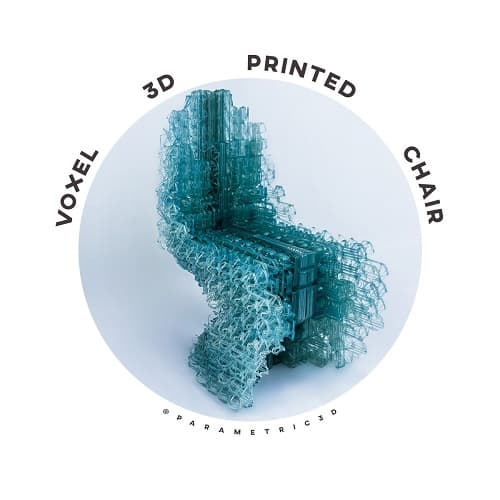
A continuous line of plastic makes up this intricate robot-built chair, designed using a new 3D-printing software by a team from the Bartlett School of Architecture in London. The Bartlett’s Design Computation Lab (DCL), a part of University College London, created the software to open up new possibilities for 3D printing.
Whereas most current 3D printing involves creating forms layer by layer, DCL’s software creates designs using one continuous line of material. The designs are then built by a robot that extrudes melted plastic into the air, where it quickly sets as it cools.
As well as enabling the creation of more intricate patterns, the software has a functional benefit, allowing designers to create lighter, more efficient forms without using any more material than is necessary for load bearing. It can also be used for the design of large-scale metamaterials, which have an internal structure engineered for certain behaviours, like Hasso Plattner Institute’s all-plastic door latch.

Michaela Crie Stone lives and works in Rockport, Maine, where she creates pieces that push the parameters of function by blurring the lines between art, craft, and design.

in this video, you can look at different parametric towers with parametric designs.

Drone based technology is the solution to overcome the limitation of surface road capacity in cities.

Augmented reality (AR) is the integration of digital information with the user’s environment in real-time.

Parametric Ideas for Architects @2025