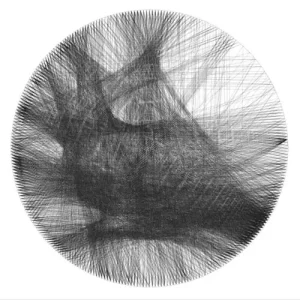
String Art Generator
String Art Generator by Yiran is a grasshopper plugin which generates a string art sequence based on an input image. You can
Abstract. This paper reports on the process and outcomes of a digital design studio that integrates parametric design and generative systems in architectural and urban design projects. It explores the interrelationship between the emergence of innovative formal representations using parametric design systems on the one hand, and design autonomy;
more specifically the conscious process of generating and developing an architectural concept, on the other. Groups of undergraduate students working on an architectural project are asked to identify a specific conceptual parti that addresses an aspect of architectural
quality, define strategies that satisfy those aspects, and computational methodologies to implement those strategies, such as rule-based systems, selforganization systems, and genetic algorithms.
The paper describes the educational approach and studio outcomes, discusses implications for CAAD education and curricula, and addresses issues to be considered for parametric and generative software development.
The adoption of parametric modeling in CAAD education is becoming increasingly prevalent. With parametric modeling software tools emerging, comes the low-hanging fruit of intuitive manipulation of parametric relations, and capture and evaluation of design information and geometry.
 Such capabilities have mostly aligned with researchers‟ goals in transforming traditional design studio from focusing on representational aspects of design into an information-centric process that embraces conceptual thinking and intuitive design exploration.
String Art Generator by Yiran is a grasshopper plugin which generates a string art sequence based on an input image. You can

This paper by Alessandro Liuti, Sofia Colabella, and Alberto Pugnale, presents the construction of Airshell, a small timber gridshell prototype erected by employing a pneumatic formwork.

In this paper by Gregory Charles Quinn, Chris J K Williams, and Christoph Gengnagel, a detailed comparison is carried out between established as well as novel erection methods for strained grid shells by means of FE simulations and a 3D-scanned scaled physical model in order to evaluate key performance criteria such as bending stresses during erection and the distance between shell nodes and their spatial target geometry.

In this paper by Frederic Tayeb, Olivier Baverel, Jean-François Caron, Lionel du Peloux, ductility aspects of a light-weight composite gridshell are developed.