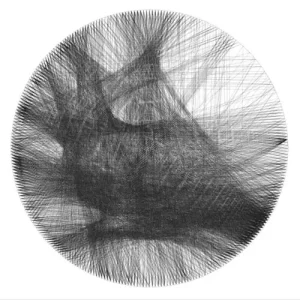
String Art Generator
String Art Generator by Yiran is a grasshopper plugin which generates a string art sequence based on an input image. You can


K-dimensional trees, abbreviated as k-d trees in the following, are binary search and partitioning trees that represent a set of n points in a multi-dimensional space. K-d tree data structures have primarily been used for nearest neighbor queries and several other query types, for example in database applications. In the context of a research project by Katja Knecht at the Bauhaus-University Weimar concerned with the development of a creative evolutionary design method for layout problems in architecture and urban design, spatial partitioning with k-d trees has been applied as a partial solution to generate floor plan layouts. Unlike, for example, packing algorithms and slicing tree structures, the employment of k-d tree algorithms in combination with evolutionary algorithms to generate floor plan layouts has not previously been examined in the scope presented here.

In the application developed in this project the k-d tree algorithm is initially used to subdivide a given rectangular area. The dividing lines thereby correspond to eventual spatial boundaries. By combining the k-d tree algorithm with genetic algorithms and evolutionary strategies, layouts can – in the current version – be optimized in three criteria dimensions (size, ratio and topology). Through user interaction the layouts can be dynamically adjusted and altered in real time. The result is a generative mechanism that provides an interesting and promising alternative to existing well- established algorithms for the creative and evolutionary solution of layout problems in architecture and urban design.

String Art Generator by Yiran is a grasshopper plugin which generates a string art sequence based on an input image. You can

This paper by Alessandro Liuti, Sofia Colabella, and Alberto Pugnale, presents the construction of Airshell, a small timber gridshell prototype erected by employing a pneumatic formwork.

In this paper by Gregory Charles Quinn, Chris J K Williams, and Christoph Gengnagel, a detailed comparison is carried out between established as well as novel erection methods for strained grid shells by means of FE simulations and a 3D-scanned scaled physical model in order to evaluate key performance criteria such as bending stresses during erection and the distance between shell nodes and their spatial target geometry.

In this paper by Frederic Tayeb, Olivier Baverel, Jean-François Caron, Lionel du Peloux, ductility aspects of a light-weight composite gridshell are developed.