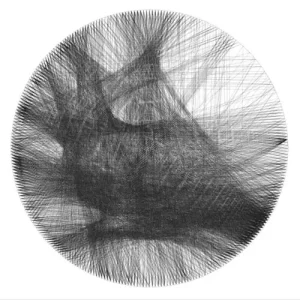
String Art Generator
String Art Generator by Yiran is a grasshopper plugin which generates a string art sequence based on an input image. You can

Optimizing Creatively in Multi-Objective Optimization

Designers will always face the challenge of designing well-performing buildings using what are often conflicting and competing performance objectives. This thesis presents a workflow called the ‘creative optimization workflow’ using a Multi-Objective Optimization (MOO) engine called Octopus that runs within Grasshopper3D, a parametric modeling tool, and multiple simulation software.

Developed as part of the workflow, the ‘creative optimization tools’ make MOO based solutions more accessible to the designer and enables the exploration and analysis of the solutions from a visual and analytical point of view. Through the juxtaposition of extreme performing solutions, serendipity is created and the potential for better multiple performing solutions is increased.
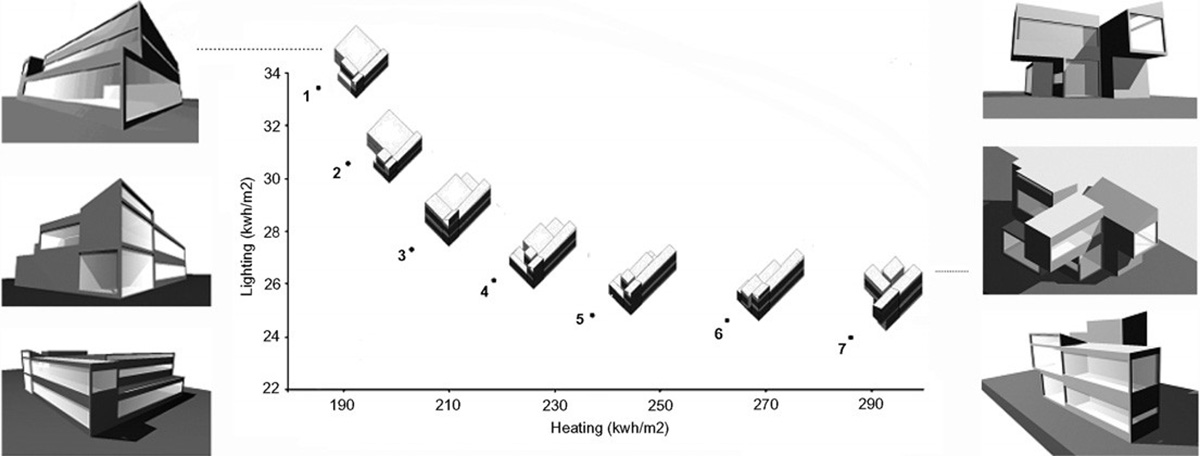
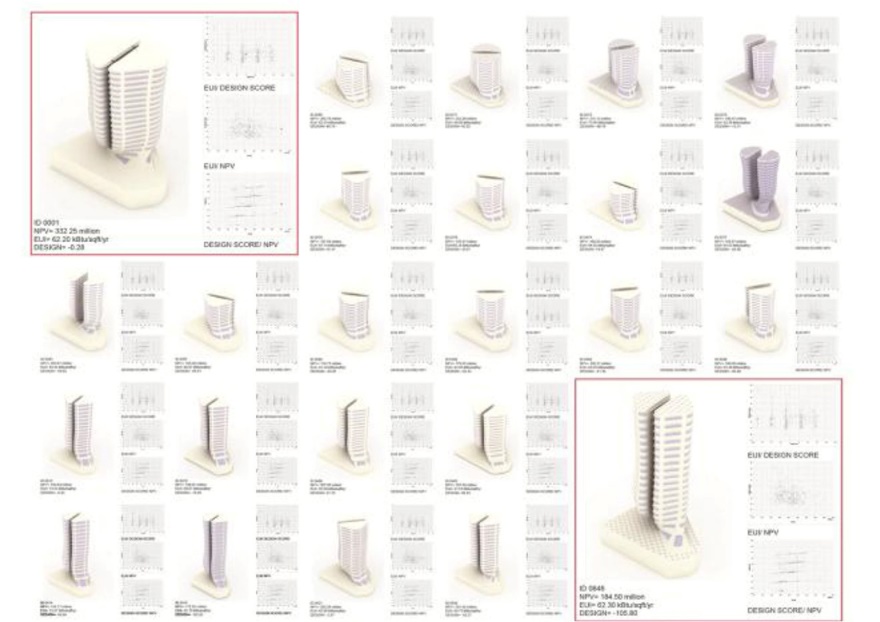
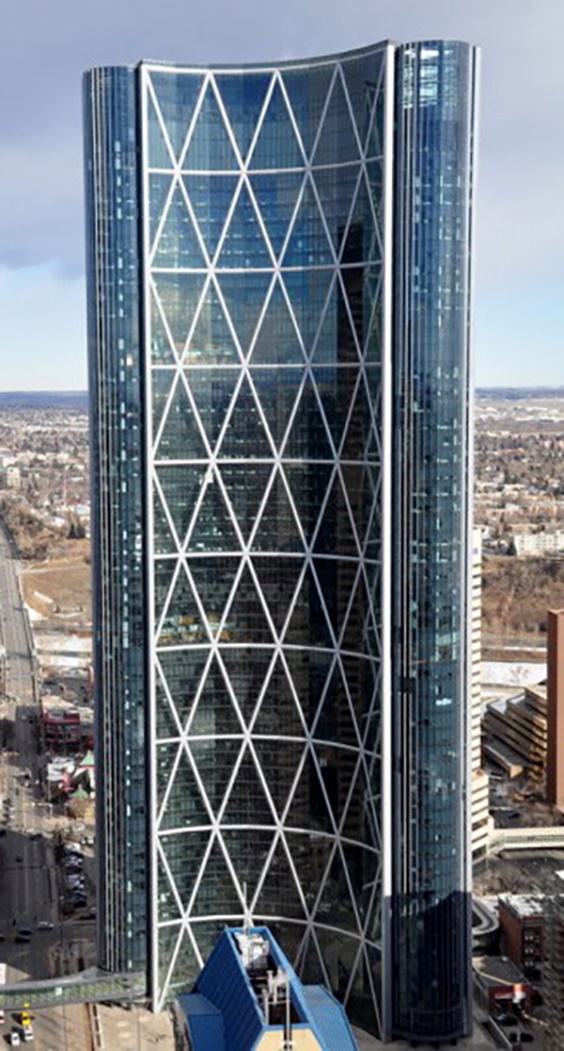
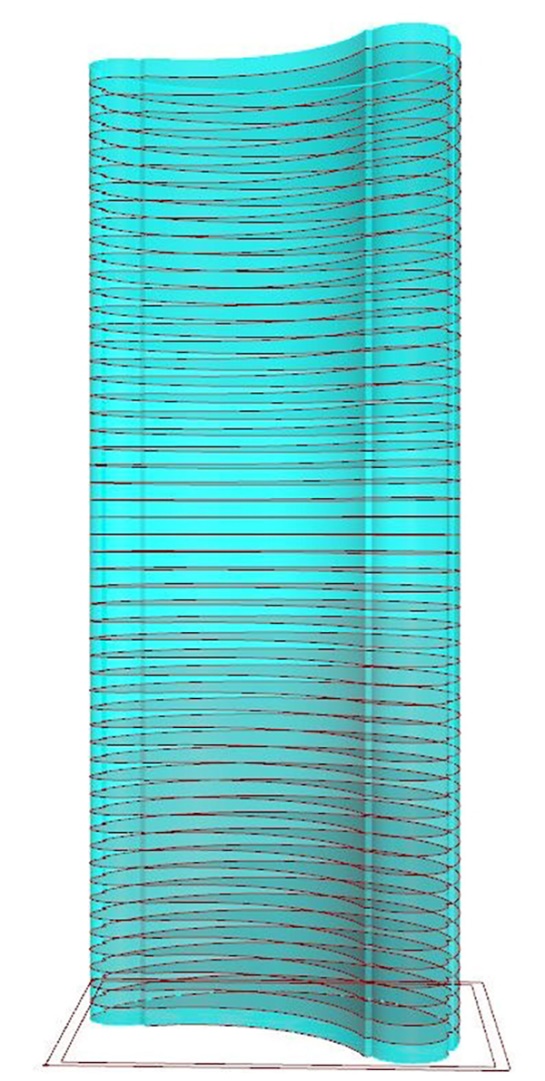
The application of the workflow on the retrospective design of two buildings, De Rotterdam and the Bow Tower, is presented. The developed workflow and tools help to reduce design latency through automated generation of design solutions, incorporate disparate performance domains including formal aesthetics and explore trade-offs of multiple solutions all within one platform.

The introduction of numerical methodologies such as structural analysis and the advent of computers encouraged the use of the scientific approach to problem solving in architectural problems. Through mathematicians whom later became architects and vice versa that substantial work in the field of CAAD (Computer Aided Architectural Design) grew significantly.
The first algorithms were used for generating building layouts in 1960s, the shell design of the Sydney Opera House required Arup’s use of analysis software (Gero & Radford, 1988) and, the first integrated package for building performance appraisal was used in 1972 (Maver, 2002). It was in the seventies that “a battery of computer aids for providing the designer with evaluative feedback on his design proposals” were developed.
Optimization is one method that designers could use to aid in the search for a ‘good’ solution. Optimization in design developed mainly into two directions over the past few decades: the automation of solving specific architectural problems such as building layouts and; the development of interactive formal design tools that can be coupled with simulation tools.

Specifically Multi-Objective Optimization or Multi-Criteria Design Optimization (MOO/MCDO) or Pareto optimization was developed primarily for and by industrial engineers in the aerospace and automobile industry. Pareto optimization is “more realistic and useful for design”, according to Gero & Radford (1988), “because it allows subjective criteria to be taken into account.”

Compared to other optimization techniques, Pareto based optimization is currently the leading multi-objective search technique based on the work of economist Vilfredo Pareto (Davis, 2009; Benjamin, 2012). Advancements in building performance simulation software and easier coupling between generative and simulation software streamlined the path towards performance-based generative design (Kolarevic, 2004).
Defining the performative objectives of a design and balancing between what are often conflicting objectives in an effective way is a central challenge for designers. For example, a design can perform very well in one particular domain (such as, for example, daylight factor performance) yet does not perform well in other domains (such as financial performance).

Notably, design performativity has been at the forefront of architectural discourse mainly because of the sustainability agenda that has become part of the social and political climate. Performative design is defined as a design performing on multiple domains: quantitatively (thermal, lighting, structural, etc.) and qualitatively (economical, spatial, aesthetics, etc.) (Kolarevic, 2005).
A well –performing solution representing all objectives optimized is rare, hence, the exploration of sub-optimal designs is necessary and the study of their trade-offs is necessary.
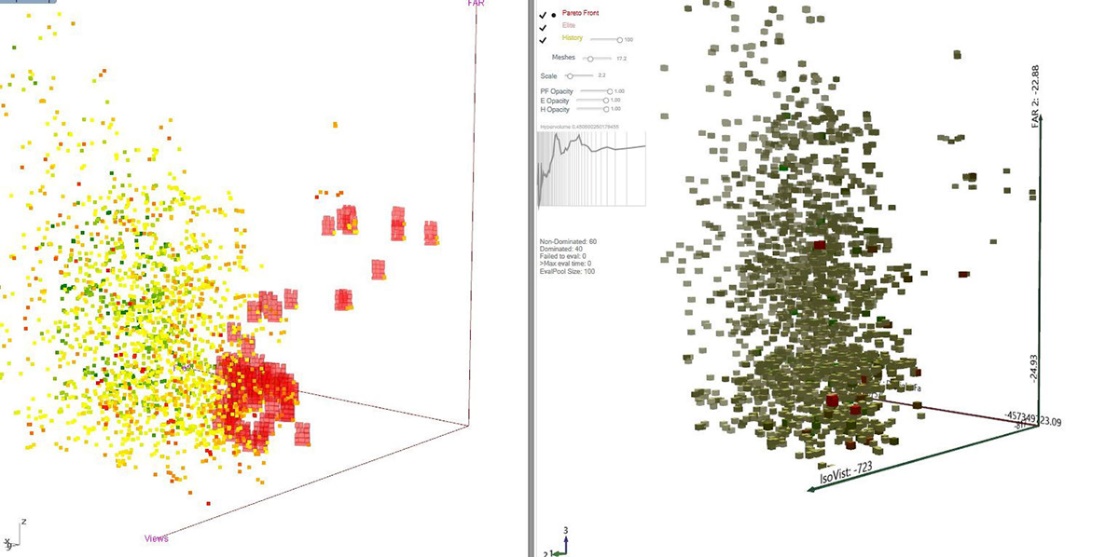
This study is dependent on the use of the already available MOO engine (Octopus) as a black box to carry out the optimization process. The methodology implemented in this study enables designers to explore multiple performance objectives of a design during the early design stage using both quantitative metrics and form performance.


Moreover, the workflow integrates MOO, simulation tools and the developed information visualization tools into a design/modeling tool, which mitigates the interfacing and exchanging of data. The proposed workflow is intended to provide flexibility by allowing the possibility of exploring disparate performance domains in a meaningful manner with reduced design latency due to the automation of the generation of solutions for different design problems.
Optimization, effectively is the search for the ‘best’ possible solution relative to the design problem and designer’s predefined objectives. The process of optimization represents the pursuit of making something as efficient and/or effective as possible within a certain context.
Optimization uses algorithms in order to generate prescriptive information on the nature of an optimal solution through the evaluation of an explicit objective within various constraints (Gero & Radford, 1988).
String Art Generator by Yiran is a grasshopper plugin which generates a string art sequence based on an input image. You can

This paper by Alessandro Liuti, Sofia Colabella, and Alberto Pugnale, presents the construction of Airshell, a small timber gridshell prototype erected by employing a pneumatic formwork.

In this paper by Gregory Charles Quinn, Chris J K Williams, and Christoph Gengnagel, a detailed comparison is carried out between established as well as novel erection methods for strained grid shells by means of FE simulations and a 3D-scanned scaled physical model in order to evaluate key performance criteria such as bending stresses during erection and the distance between shell nodes and their spatial target geometry.

In this paper by Frederic Tayeb, Olivier Baverel, Jean-François Caron, Lionel du Peloux, ductility aspects of a light-weight composite gridshell are developed.