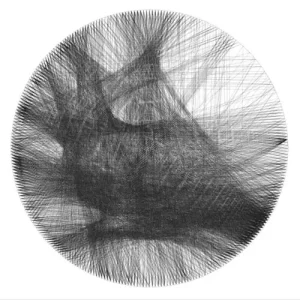
String Art Generator
String Art Generator by Yiran is a grasshopper plugin which generates a string art sequence based on an input image. You can
Tailoring Self-Formation

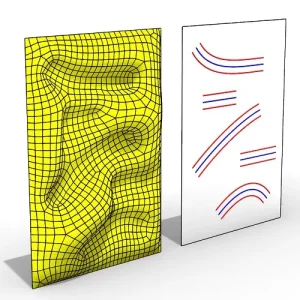
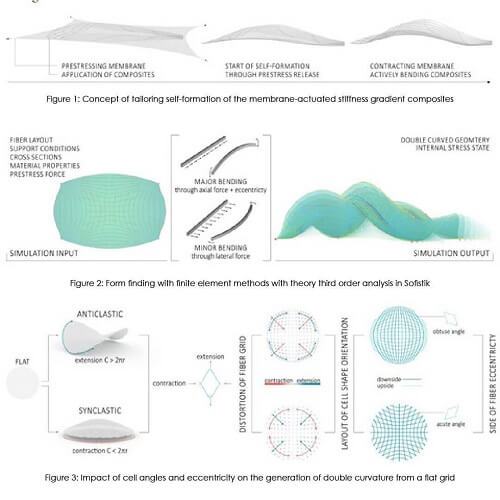
This paper presents a design to fabrication framework for the mold-less construction of double curved composite lattice surfaces based on inherent material behavior. Fiber reinforced composite strands are sewn onto a flat prestressed high-strain membrane with the tailored fiber placement technique.
Through the prestress release the contracting membrane actuates active bending of the composite elements, thus the system self-forms into an anticipated double curved geometry. Its geometric outcome is tailored by the stiffness gradient of the composites. The material system is introduced by the authors with the term membrane-actuated stiffness gradient composites (MASGC).
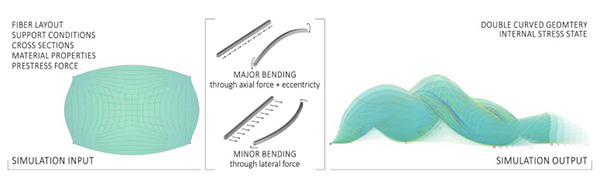
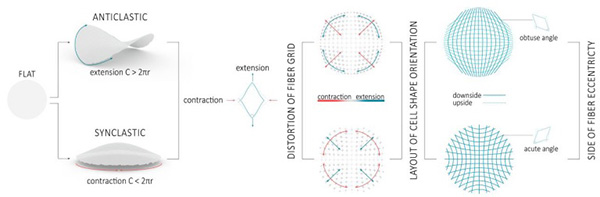
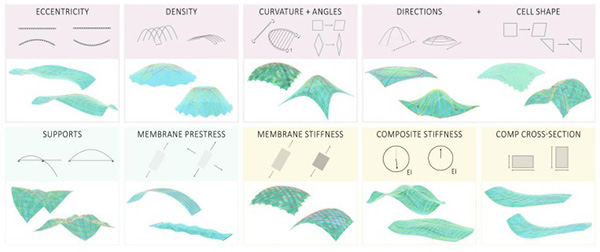
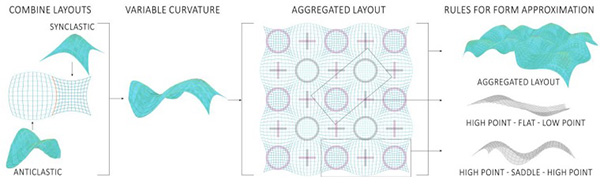
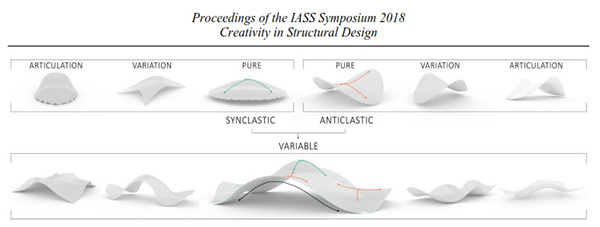
The primary focus of this research is to establish the rules of self-formation on the basis of the system’s governing parameters. Therefore, the fundamentals of the generation of synclastic and anticlastic curvatures, as well as combinations of both, from flat fibrous grids are revealed. Simulations with nonlinear finite element methods are deployed for the MASGC’s form finding.
The resulting understanding leads to the definition of rules for a form approximation process, where the system’s input parameters are determined so that the self-formation satisfies an initial design intention. This control enables the exploration of the MASGC’s design space.
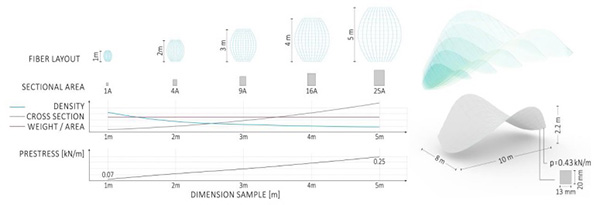
Furthermore, the MASGC’s scalability and structural performance is evaluated. The proposed system offers the advantage to build lightweight surfaces of tailored variable double curvatures through rapid digital fabrication and mold-less formation.
The demand for customized double curved surfaces is increasing in contemporary architectural design and construction. These surfaces are of interest by virtue of their appealing form as well as their advantageous structural performance among others. Fiber reinforced polymers (FRP) offer a high degree of customization and the ability to construct lightweight structures.
Thus composite panels find application as façade elements with customized freeform shapes. However, their complex and costly fabrication is a current issue throughout all design fields. Conventionally double curved composites are manufactured through manual lamination onto CNC-milled expanded polystyrene molds. This entails a vast amount of waste, technology and labor.
Consequently, this mold process is more suitable for mass production, rather than for individualized designs as are common in the field of avant-garde architecture. Alternatively, double curved geometries can be formed by initially planar grids undergoing distortion or by tessellation into planar segments or into bending-active developable plates. However, these solutions result in less smooth surfaces and necessitate erection and connection strategies.
A basis for an intelligent method to shape complex geometries is through a system inherent material behavior. Research has been conducted by on material behavior based design, where solely through the interaction of contracting actuators and bending elements, forms are generated in one-step without molds.
Yet, their behavior is not investigated to a degree where an anticipated geometry with controlled Gaussian curvature can be formed. Moreover, this would demand freedom and control in the stiffness layout. Digital fabrication with the tailored fiber placement technology (TFP), originating from the aerospace industry, enables a precise and automated fiber reinforced composite application onto a substrate membrane. Conventionally their fiber layouts are informed for an optimized structural performance, while their geometry is formed through molding.
This research aims to combine the presented advantages in a material system introduced by the authors with the term membrane-actuated stiffness gradient composites (MASGC). The proposed system offers the construction of lightweight, composite surfaces of tailored variable double curvatures through rapid digital fabrication and mold-less self-formation, relying solely on the systems inherent material behavior.
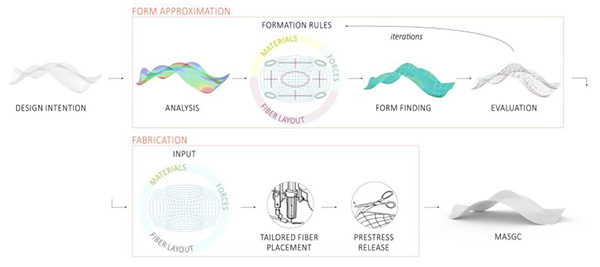
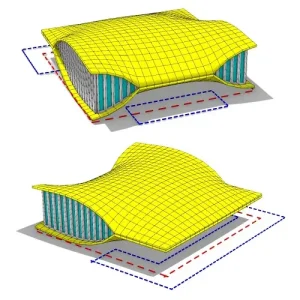
Thus, it offers a high degree of customization and in return minimizes material use, labor and waste. Fiber reinforced composite strands are sewn onto a flat prestressed high-strain membrane with the tailored fiber placement technique. Through the prestress release the contracting membrane actuates active bending of the composite elements, thus the system self-forms into an anticipated double curved geometry (Figure 1).
Its geometric outcome is tailored by the stiffness distribution and fiber layout. Through extensive form-finding with nonlinear finite element methods, self-formation rules are derived that enable form approximation. A process where the input parameters of the system are determined so that the self-formation satisfies an initial design intention. The research on the MASGC is concluded in a design to fabrication framework.

With the proposed concept of tailoring self-formation with the MASGC, composite surfaces with a wide range of designs exhibiting positive, negative and variable Gaussian curvatures can be formed solely through the material behavior of the system. The design to fabrication framework enables the fabrication of customized surfaces with high geometric control in a digital fabrication and mold-less, one-step formation process.

This control is achieved through the establishment of the self-formation rules. It is demonstrated that all the parameters of the system, in particular the membrane stiffness, eccentricity and cross-sectional ratio, determine the self-formation into double curved surfaces. However, the most crucial aspect for controlling double curvature in the MASGC is the insight on the impact of the cells angles and their distortion.
This can be considered a vital contribution to the general discourse on the control of double curvature. Furthermore, the critical dilemma of bending active structures, of too stiff for formation and too weak for structural performance can be overcome, through the deployment of the stiffness change over curing time of the composites.
String Art Generator by Yiran is a grasshopper plugin which generates a string art sequence based on an input image. You can

This paper by Alessandro Liuti, Sofia Colabella, and Alberto Pugnale, presents the construction of Airshell, a small timber gridshell prototype erected by employing a pneumatic formwork.

In this paper by Gregory Charles Quinn, Chris J K Williams, and Christoph Gengnagel, a detailed comparison is carried out between established as well as novel erection methods for strained grid shells by means of FE simulations and a 3D-scanned scaled physical model in order to evaluate key performance criteria such as bending stresses during erection and the distance between shell nodes and their spatial target geometry.

In this paper by Frederic Tayeb, Olivier Baverel, Jean-François Caron, Lionel du Peloux, ductility aspects of a light-weight composite gridshell are developed.