Symmetrical Scissors
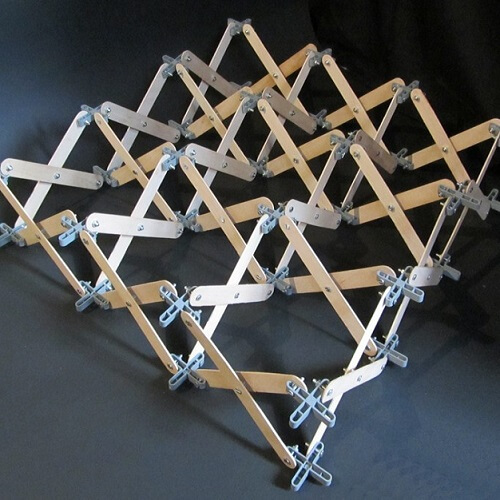
The central topic of this work by SMiA Research Group is the explanation of the making process of a scale model, which makes a spatial grouping of symmetrical straight scissors.
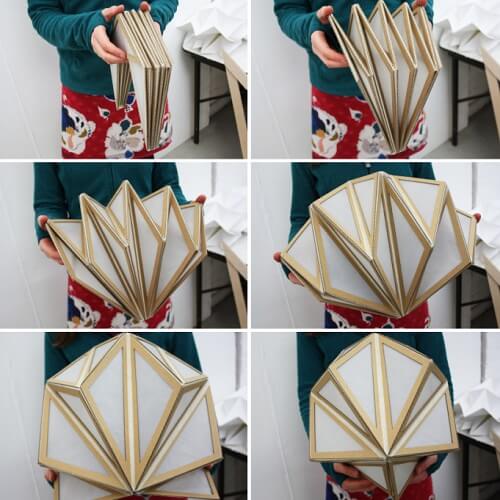
Origami Shelter by Hannah Imlach (birch plywood, ripstop nylon and cotton webbing, 2011) investigates subtle changes in natural light. The sculpture is a portable, foldable space, large enough to fit two adults lying comfortably inside.
The interactive art work “Intentions 2” produced by students of the Faculty of Media Studies Cross Media Course won the Knowledge Award at the 21st Student CG Contest (sponsored by the CG-ARTS Association).
French for “single shell,” Monocoque by Neri Oxman stands for a construction technique that supports structural load using an object’s external skin. This approach promotes heterogeneity and differentiation of material properties.
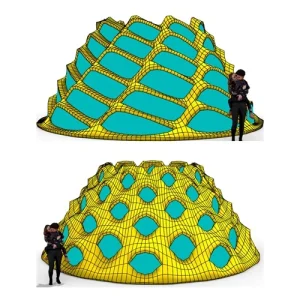
At the start of 2018, the Higher Technical School of Construction Engineering at the University of Seville launched an ambitious project to build an experimental pavilion – the “Bubble Pavilion” – using plywood panels as the raw material.
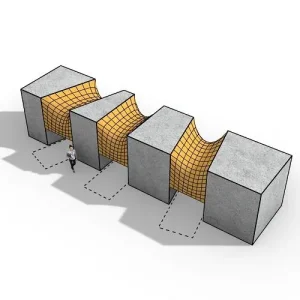
O-STRIP Pavilion is one of the projects in Tongji University’s Fabrication workshop that aims to bring back the liveliness of the place. The site is located at a sinking space of the teaching building, which connected with an indoor exhibition hall.
David Spriggs’ Vision artwork series have a distinct focus on the senses. Accentuated by an affinity between its subject matter and the fragmentary nature of the medium, there is a tension created between form and emptiness.
Harmen Design group designed and digitally fabricated this interior setting for the LPD office in Toronto, using Rhino3d and it’s plugin Grasshopper3d.
Inside venice’s palazzo mora, cara lee and stephan mundwiler of leeMundwiler architects have installed ‘CHiLL’ — a ‘breathing’ structure that kinetically responds to human interaction.
Designed by penda, the cola-bow installation is a public art installation made out of more than 17,000 recycled plastic bottles, which were braided to create a shape inspired by the swings of the Coca-Cola logo.
Iridescence Print by Gramazio Kohler Research is the first large-scale architectural installation to be automatically printed by robotic machines.
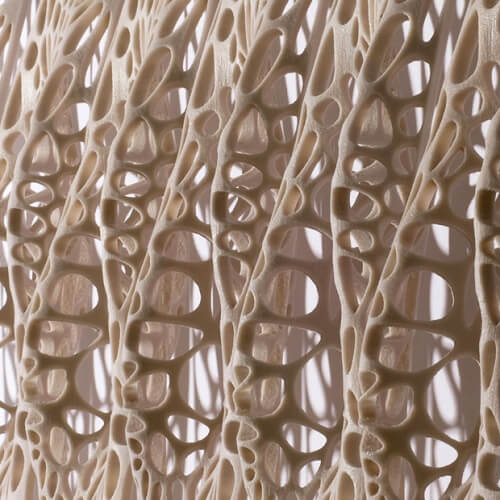
The School of Architecture at Saarland University in Saarbrücken, Germany, have lead a collaborative research project into bionic inspired wooden shell structures.
Desert Lotus is an expanding dome designed by Michael Burton. The goal of the project was to create a kinetic structure that could act as a collapsable, temporary installation or kiosk.
Ai Build presented “Daedalus Pavilion”, a 3D printed architectural installation built by robots, as part NVIDIA’s GPU Technology Conference in Amsterdam (28-29 September 2016).
“Urban Imprint” is an immersive, kinetic, outdoor installation by Studio INI, exhibited at NYCxDesign for A/D/O by MINI, in Brooklyn, New York.
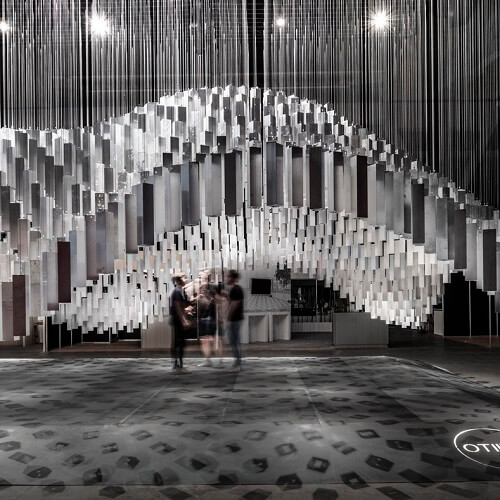
Inside the construction fair BB Construmat 2017, hangs the new stand for the company Alumilux, pioneer in constructive solutions in aluminum, metal and glass. Stand Alumilux was designed by Jaime Prous Architects.
Bradford Hansen-Smith has been experimenting with structures made from a great many 10-inch bamboo skewers held together with short pieces of rubber tubing. He calls the technique stickweaving.
Located in the heart of Wujin, the burgeoning southern district of Changzhou, Jiangsu PRC, the Lotus Building by Studio 505 and the 3.5 hectare People’s Park has been designed to act as a cultural anchor and civic landmark.
MoveART partnered with All Urban LTD to design a play sculpture named Climbslide 8.0. While adults will appreciate «climb slide 8.0» as an aesthetically designed play sculpture, children will see it as a small world full of adventures.
Lyle London is an artist and sculptor. Over the last few years, he has developed a series of works based on the spiral topologies observed in natural phenomena.