String Art Generator
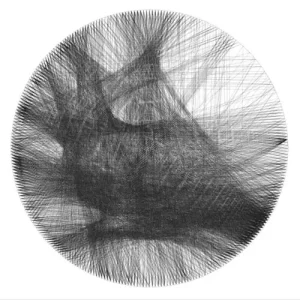
String Art Generator by Yiran is a grasshopper plugin which generates a string art sequence based on an input image. You can
Bending-active reciprocal structures based on equilateral polyhedral geometries
As mutually supported beam structures, reciprocal frames limit the number of components that are joined at each connection to two. However, this system of intermediate connections introduces undesirable bending moments in the beam elements.
By utilising elastic deformation to create curved geometries, bending-active structures show the potential of bending as a formation process. Moreover, the curved geometries showcase an increased resistance to bending. Despite the apparent potential, only a few geometric explorations of bending-active reciprocal structures exist.
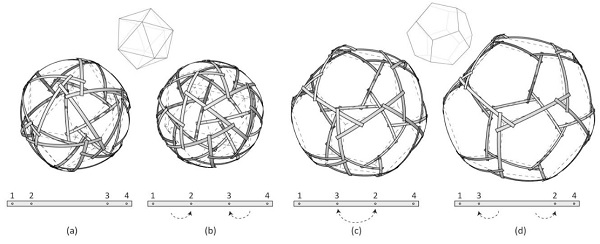
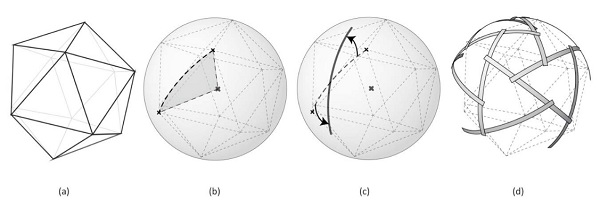
Therefore, we investigated the principle by developing a design methodology based on polyhedral shapes. As this work is part of a research on transformable, rapidly assembled structures, the focus lies on simplicity of the connections, uniformity of the components and reconfigurability.
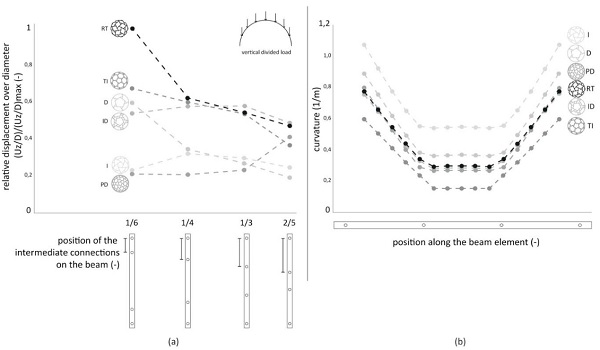
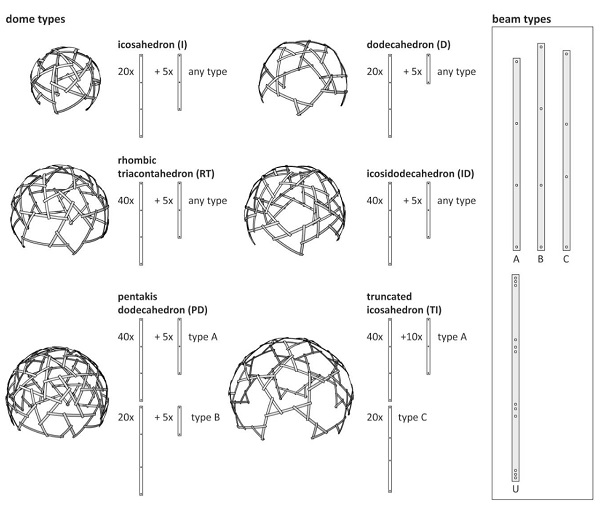
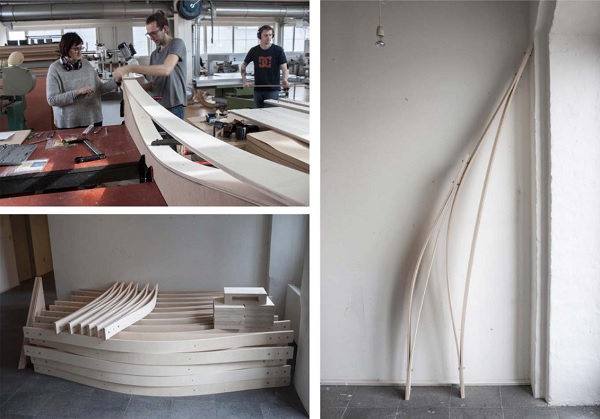
This paper discusses the development of a kit of parts of reciprocal bending-active components based on a selection of polyhedral dome types. To simplify the assembly of the structures and avoid the manual bending of the components on site, we introduce the concept of a double-layered, pre-bent component.
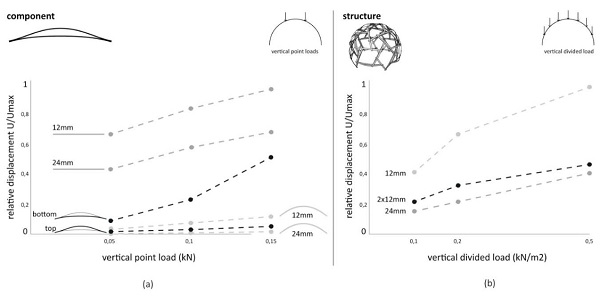
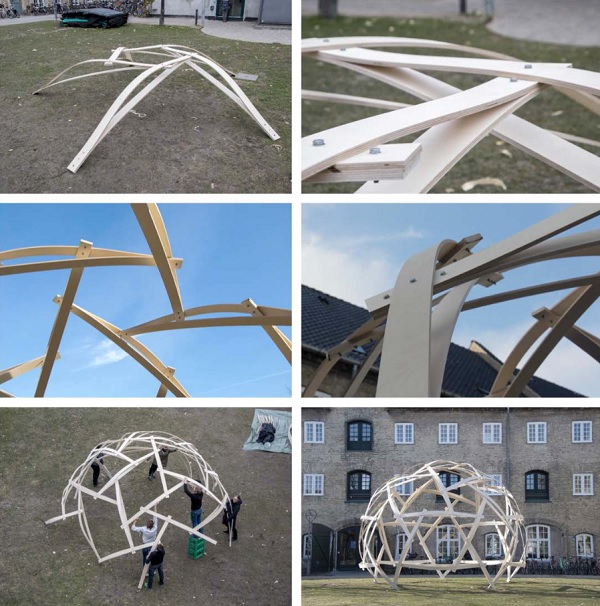
Finally, this paper presents the development, fabrication and assembly of the ReciPlyDome, a full-scale prototype of a bending-active reciprocal dome with double-layered components. Preliminary analyses of the load-bearing behaviour show the potential of these systems for material-efficient, lightweight structures.
The research presented in this paper contributes to the understanding of bending-active reciprocal frames as a structural principle for temporary and rapidly assembled structures.
Reciprocal frame structures consist of a grid of mutually supported beams. The organisation of these beam elements in a weave pattern invokes structural stability and limits the number of elements joined at each connection to two.
The resulting reduced complexity of the nodes and the ability of creating grid structures with shorter, discontinuous elements are the main advantages of reciprocal frames.
The induction of bending forces due to the intermediate connections is a significant drawback, often causing the disfavour of reciprocal structures towards other structural systems.
On the other hand, recent advances in the design and analysis of bending-active structures show the potential of bending as a formation process for curved structures. The elastic deformation of flexible components allows the assembly of curved structures from flat or linear elements and facilitates reuse, transport and reconfiguration thanks to its reversible nature.
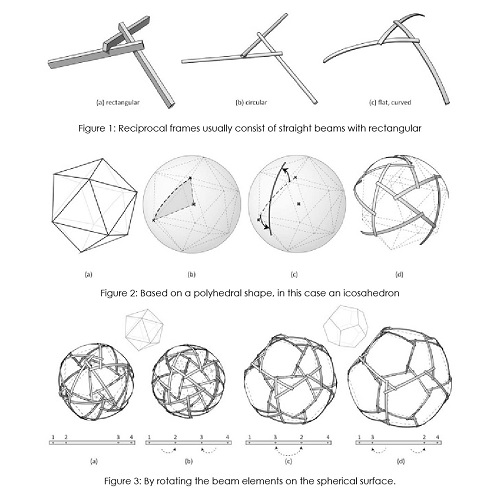
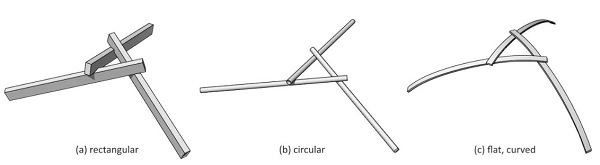
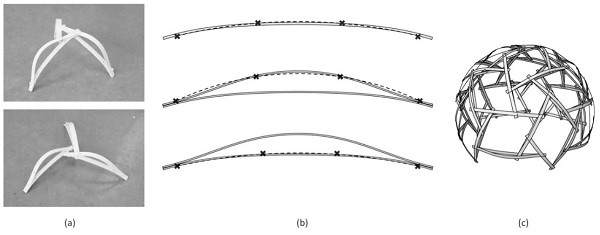
Thus, the potential of bending-active reciprocal structures lies in the beneficial manipulation of bending forces to further simplify fabrication and detailing. Figure 1 shows a reciprocal configuration of three bending-active elements with flat cross-section next to the commonly used rectangular and circular ones.
Whereas the beam inclinations constitute a certain joint complexity with cutouts or inclined bolt holes for the latter, bending-active elements create the inclination by their curvature, enabling simple bolted connections between tangential planes.
String Art Generator by Yiran is a grasshopper plugin which generates a string art sequence based on an input image. You can

This paper by Alessandro Liuti, Sofia Colabella, and Alberto Pugnale, presents the construction of Airshell, a small timber gridshell prototype erected by employing a pneumatic formwork.

In this paper by Gregory Charles Quinn, Chris J K Williams, and Christoph Gengnagel, a detailed comparison is carried out between established as well as novel erection methods for strained grid shells by means of FE simulations and a 3D-scanned scaled physical model in order to evaluate key performance criteria such as bending stresses during erection and the distance between shell nodes and their spatial target geometry.

In this paper by Frederic Tayeb, Olivier Baverel, Jean-François Caron, Lionel du Peloux, ductility aspects of a light-weight composite gridshell are developed.