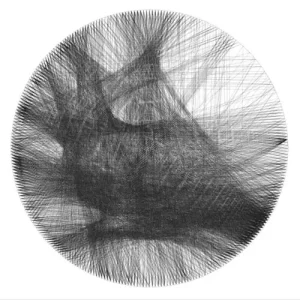
String Art Generator
String Art Generator by Yiran is a grasshopper plugin which generates a string art sequence based on an input image. You can


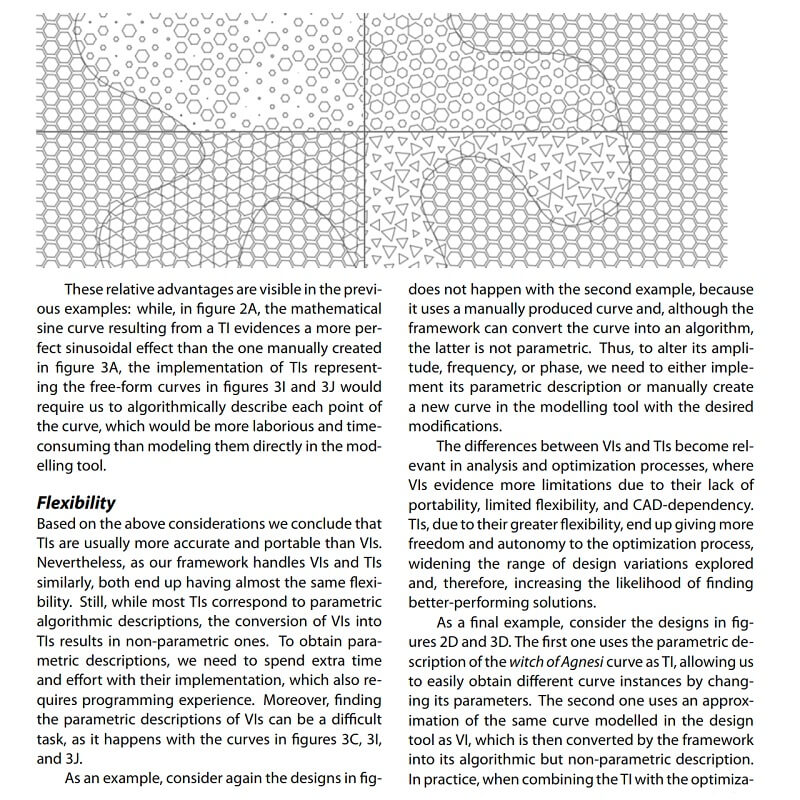
Facade design is becoming increasingly complex, forcing architects to more frequently resort to analysis and optimization processes. However, these processes are time-consuming and require the coordination of multiple tools. Algorithmic Design (AD) has the potential to overcome these limitations through the use of algorithms implemented in Textual Programming Languages (TPLs) or Visual Programming Languages (VPLs).
 VPLs are more used in architecture due to their smoother learning curve and user-friendliness, but TPLs are better suited than VPLs for handling complex AD problems. To make TPLs more appealing to architects, Inês Caetano and António Leitão incorporated VPLs’ features in the textual paradigm, namely, Visual Input Mechanisms (VIMs).
 In this paper, They propose an extension to an existing AD framework for the design exploration, analysis, and optimization of facades to support a TPL-based approach that handles VIMs.
String Art Generator by Yiran is a grasshopper plugin which generates a string art sequence based on an input image. You can

This paper by Alessandro Liuti, Sofia Colabella, and Alberto Pugnale, presents the construction of Airshell, a small timber gridshell prototype erected by employing a pneumatic formwork.

In this paper by Gregory Charles Quinn, Chris J K Williams, and Christoph Gengnagel, a detailed comparison is carried out between established as well as novel erection methods for strained grid shells by means of FE simulations and a 3D-scanned scaled physical model in order to evaluate key performance criteria such as bending stresses during erection and the distance between shell nodes and their spatial target geometry.

In this paper by Frederic Tayeb, Olivier Baverel, Jean-François Caron, Lionel du Peloux, ductility aspects of a light-weight composite gridshell are developed.