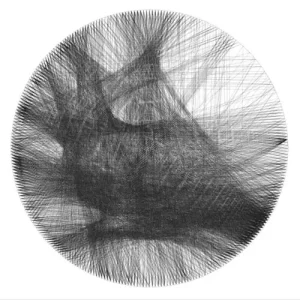
String Art Generator
String Art Generator by Yiran is a grasshopper plugin which generates a string art sequence based on an input image. You can

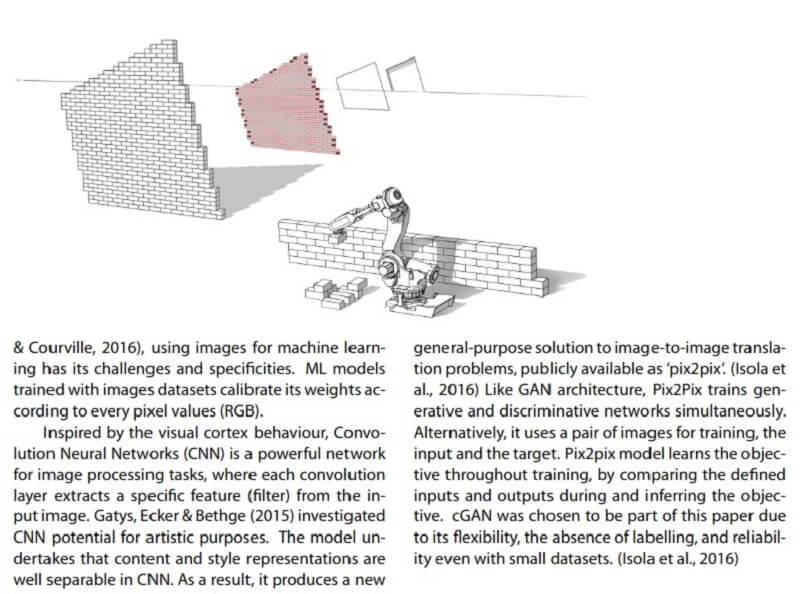
Brickwork is the oldest construction method still in use. Digital technologies, in turn, enabled new methods of representation and automation for bricklaying. While automation explored different approaches, representation was limited to declarative methods, as parametric filling algorithms. Alternatively, this work proposes a framework for automated brickwork using a machine learning model based on image-to-image translation (Conditional Generative Adversarial Networks).
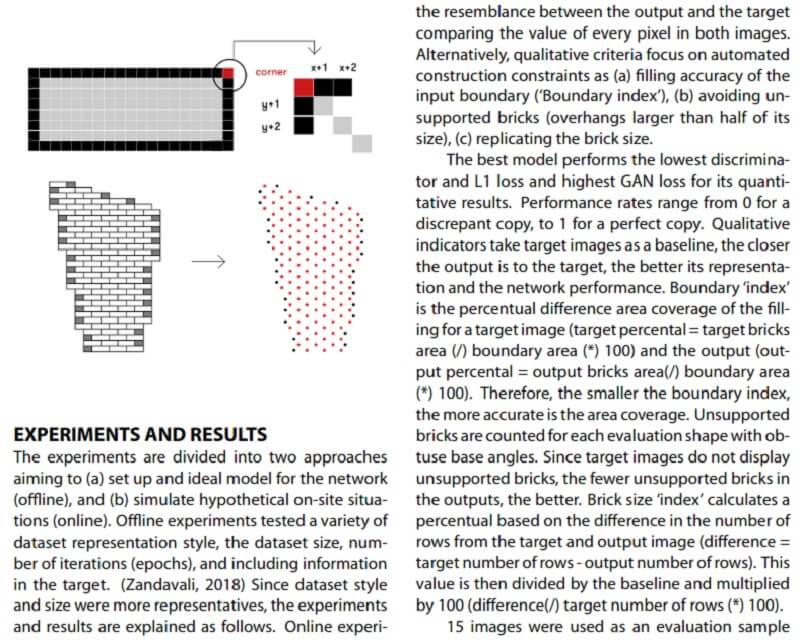
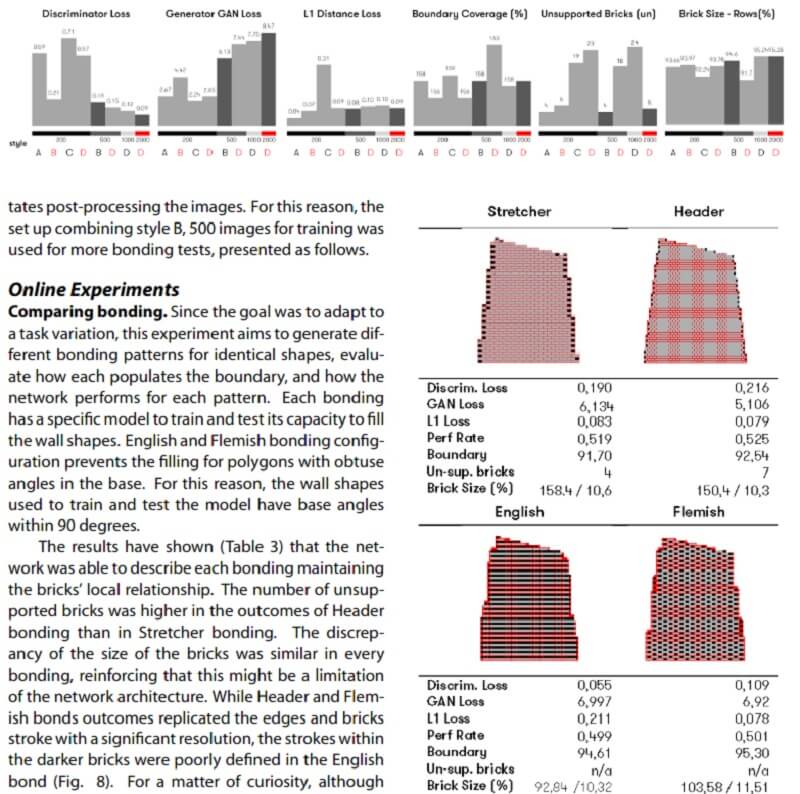
The framework consists of creating a dataset, training a model for each bond, and converting the output images into vectorial data for robotic assembly. Criteria such as: reaching wall boundary accuracy, avoidance of unsupported bricks, and brick’s position accuracy were individually evaluated for each bond. The results demonstrate that the proposed framework fulfills boundary filling and respects overall bonding structural rules. Size accuracy demonstrated inferior performance for the scale tested. The association of this method with ‘self-calibrating’ robots could overcome this problem and be easily implemented for on-site.
String Art Generator by Yiran is a grasshopper plugin which generates a string art sequence based on an input image. You can

This paper by Alessandro Liuti, Sofia Colabella, and Alberto Pugnale, presents the construction of Airshell, a small timber gridshell prototype erected by employing a pneumatic formwork.

In this paper by Gregory Charles Quinn, Chris J K Williams, and Christoph Gengnagel, a detailed comparison is carried out between established as well as novel erection methods for strained grid shells by means of FE simulations and a 3D-scanned scaled physical model in order to evaluate key performance criteria such as bending stresses during erection and the distance between shell nodes and their spatial target geometry.

In this paper by Frederic Tayeb, Olivier Baverel, Jean-François Caron, Lionel du Peloux, ductility aspects of a light-weight composite gridshell are developed.