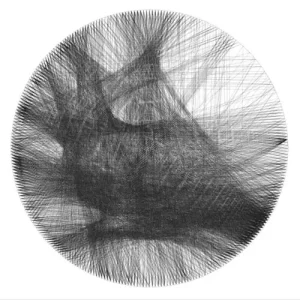
String Art Generator
String Art Generator by Yiran is a grasshopper plugin which generates a string art sequence based on an input image. You can
A high integration of design and research between architects, computational designers, and consultants is important to achieve innovation and efficiency. Communicating to the designer the importance of integrating performance-based approaches in the early design stage and their impact on the design, may shift the logic of executing an architectural project.
The integration of daylighting into the design phase, through design tools and computation, results in the improved performance of daylight harvesting and therefore tackles issues of human comfort and energy efficiency. One example of performance-based integration is the design, simulation, and validation of intelligent features in building skin design and its impact on daylighting performance.; This thesis presents the design of an algorithm and parametric process developed in Grasshopper, a plugin for Rhino 3D, using DIVA for daylighting simulation.
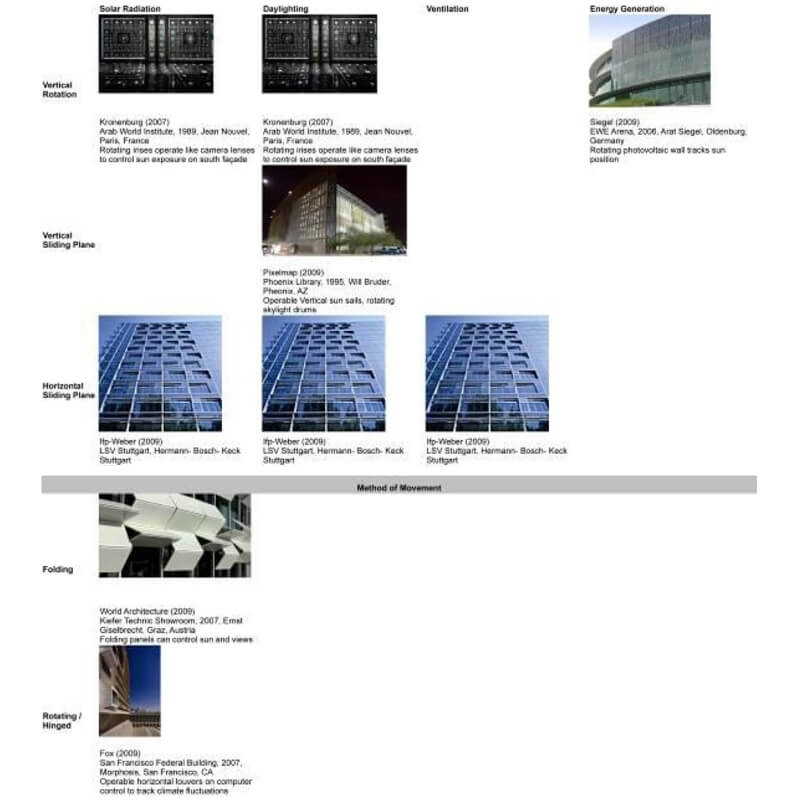
The main objective of the process and algorithm is to evaluate the performance of an intelligent façade, composed of a series of kinetic louvers that actuate in response to dynamic daylighting, and the incorporation of occupants’ preferences. Within the framework of this study, Grasshopper as a parametric computational tool allows the integration of Rhino, the design space, and DIVA, the dynamic daylighting tool, into a single process.
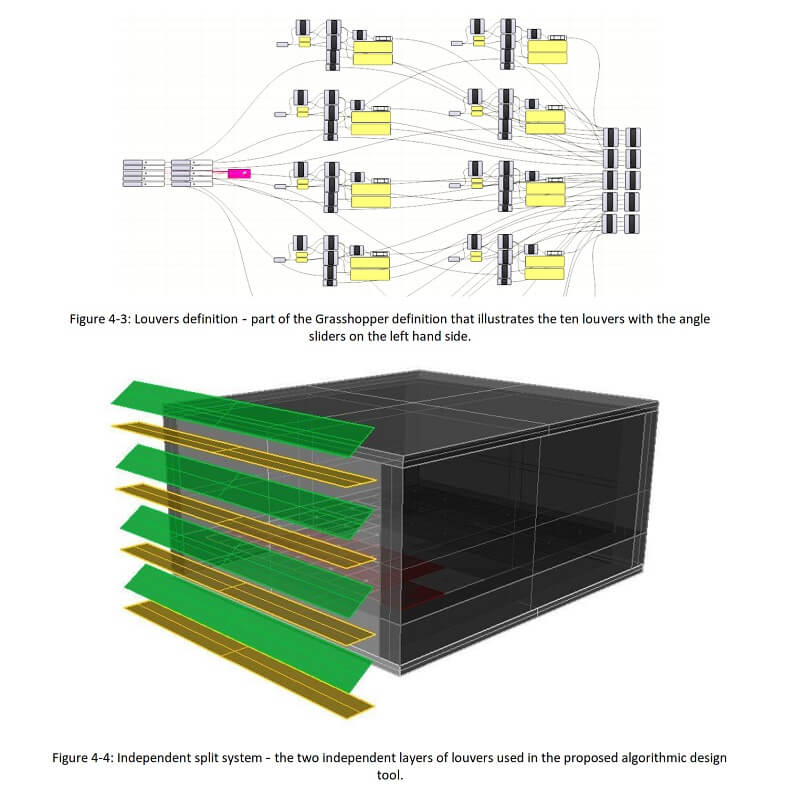
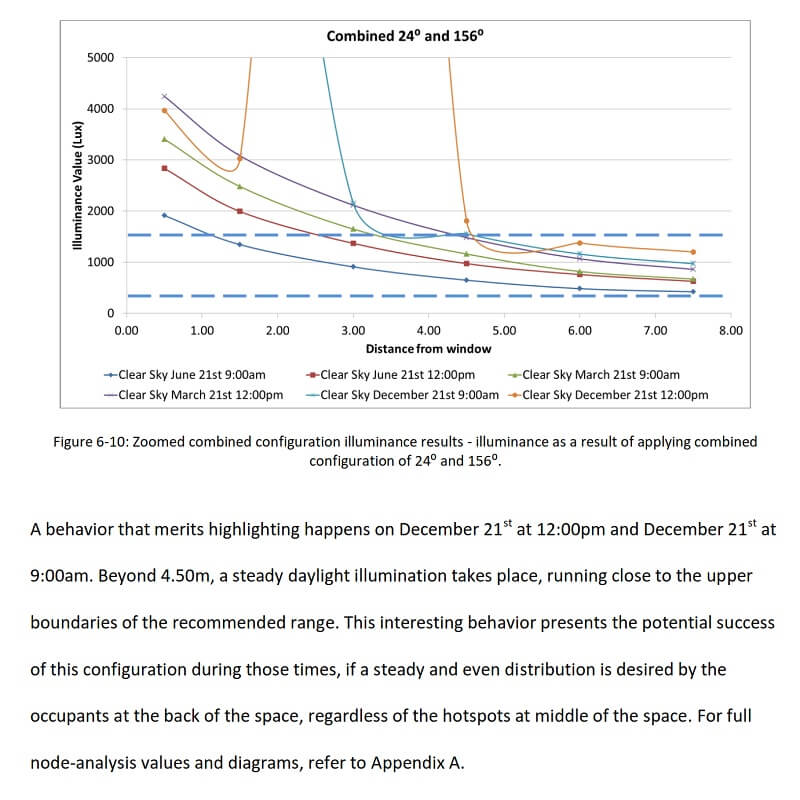
The parametric tool extracts the designed geometry from the modeling space and inputs it into the DIVA component to be tested for illumination performance, luminous distribution, and daylight penetration depth inside an office space.
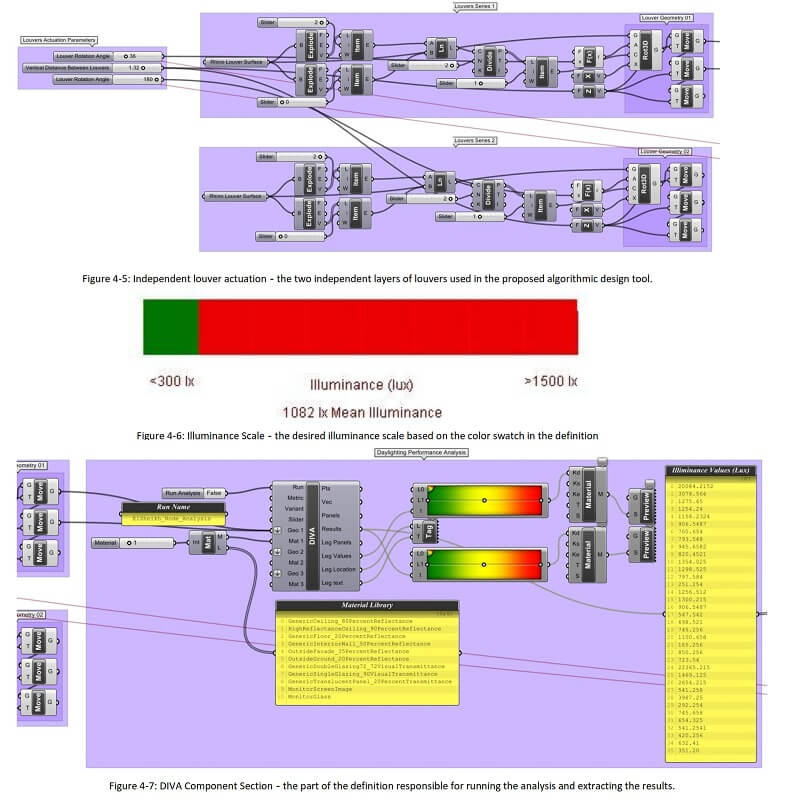
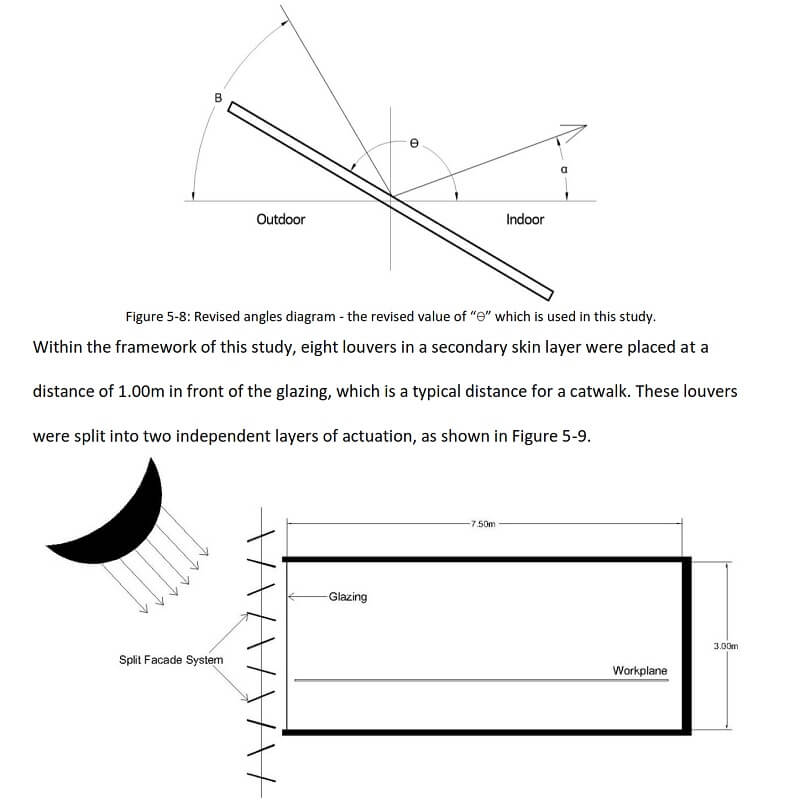
This thesis by Mohamed Mansour El Sheikh presents the initial experiment, in which the external skin actuates to optimize daylight-deflection, maintaining a desirable luminous indoor environment. In the experiment, the louvers rotate using the concept of independent tilt-angle, where every other louver has the same tilt angle; they could be in a harvesting, shading, or a combined configuration.
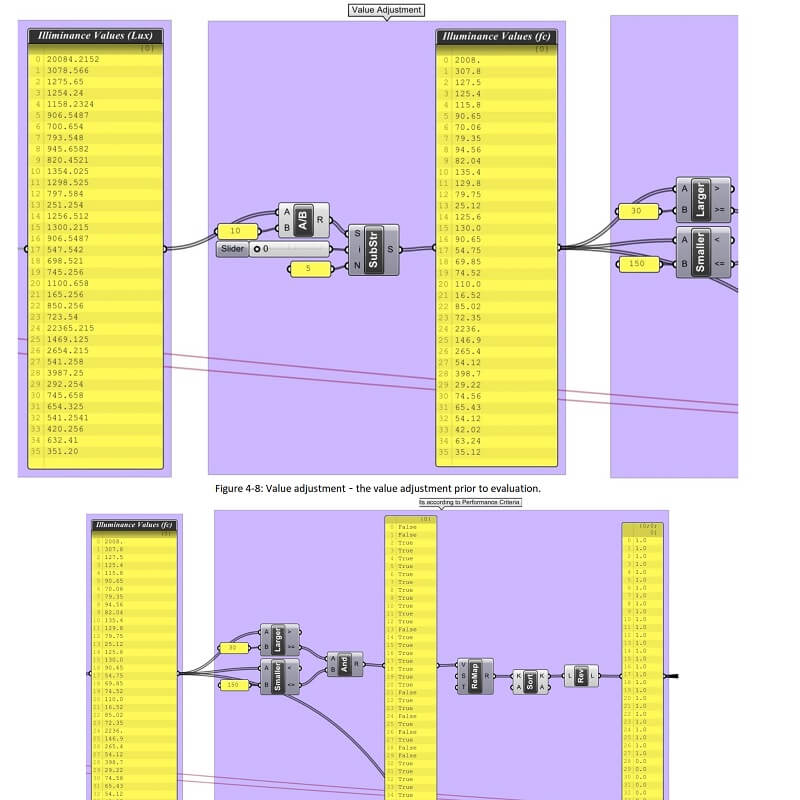
When skin configuration changes, due to louver actuation, the algorithm detects the alteration and instantly reflects it onto a calculation grid inside the space. This allows the designer to run numerous iterations during the design stage and select the best possible one based on pre-defined criteria.; A genetic algorithm has been incorporated into the definition to enable a search for the best skin configuration at specific dates and times or under different sky conditions.
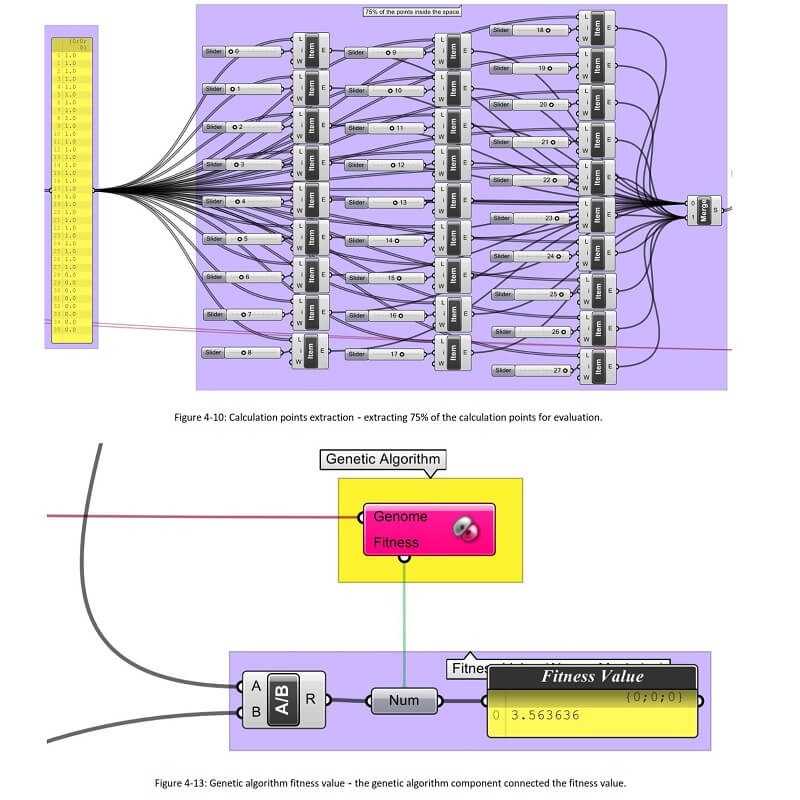
The genetic algorithm works on finding an optimal – although not necessarily the best – solution under certain parameters and conditions. These parameters could range from users’ desired illumination levels, to externally-reflected daylighting components. Changes in any of these parameters trigger the system to run and find an optimal configuration for the skin to maintain the desired luminous environment.
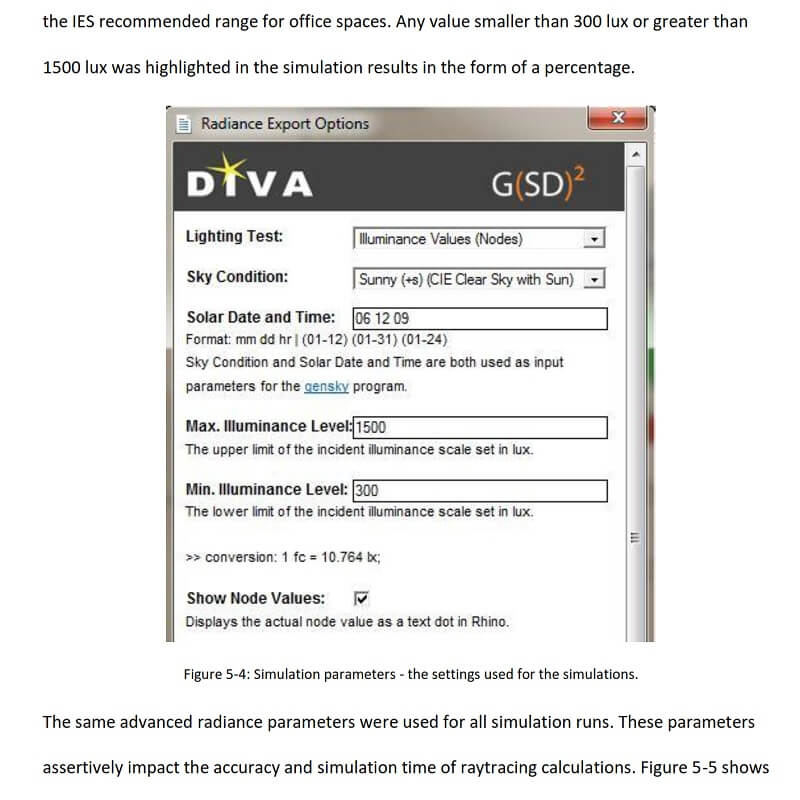
In this study, one actuation parameter and three performance indicators for daylighting are defined. However, the proposed design tool is extensible; it is open to accepting additional parameters and performance indicators, which makes it more complex for better performance assessment. As a future development, the geometry of the skin panels will be considered as a varying parameter.
String Art Generator by Yiran is a grasshopper plugin which generates a string art sequence based on an input image. You can

This paper by Alessandro Liuti, Sofia Colabella, and Alberto Pugnale, presents the construction of Airshell, a small timber gridshell prototype erected by employing a pneumatic formwork.

In this paper by Gregory Charles Quinn, Chris J K Williams, and Christoph Gengnagel, a detailed comparison is carried out between established as well as novel erection methods for strained grid shells by means of FE simulations and a 3D-scanned scaled physical model in order to evaluate key performance criteria such as bending stresses during erection and the distance between shell nodes and their spatial target geometry.

In this paper by Frederic Tayeb, Olivier Baverel, Jean-François Caron, Lionel du Peloux, ductility aspects of a light-weight composite gridshell are developed.