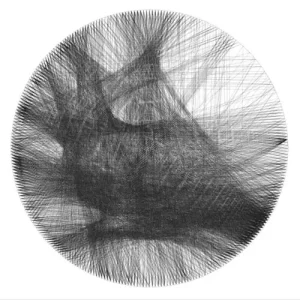
String Art Generator
String Art Generator by Yiran is a grasshopper plugin which generates a string art sequence based on an input image. You can
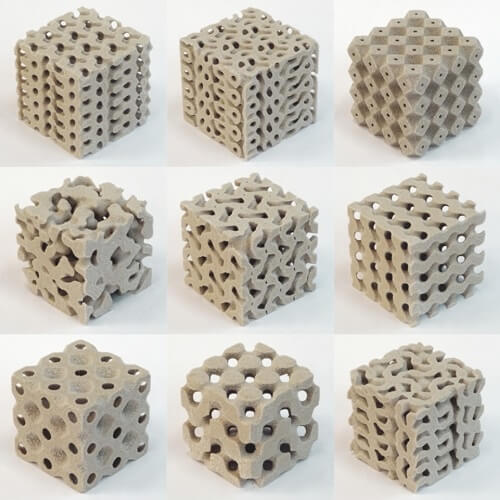
Architecture is always a symbiosis of art and technology, of rational control and the creative loss thereof. Ever since information technology found its way into architectural practices through the advent of computers, its potential has been explored not only for solving well-formulated engineering problems faster but also for creative expression and assisting in the architectural design.
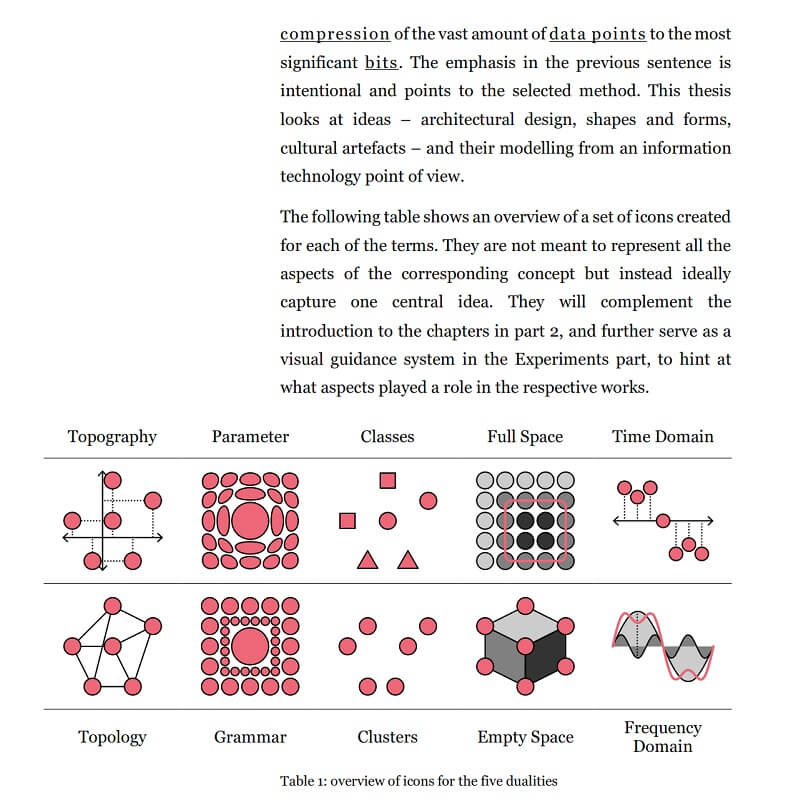
 This has given rise to a plethora of tools with various ideas and concepts, available ubiquitously to the sanguine architect. It has also led to the field of computer aided architectural design being a very heterogenous and convoluted field full of ambiguous terms and hail bringing promises.
 This thesis by Mathias Bernhard sets out to disentangle some of the confusion. More an orientation than an organisation, it seeks to provide a map of the current computational design landscape. The theoretical first part constructs a series of five dualities around design, geometry representation and their related data structures.
 The dualities are topology and topography, parameter and grammar, classes and clusters, full and empty space and finally time and frequency domain. They are examined across different disciplines, not only architecture but also biology, mathematics, linguistics and information technology.
 These different viewpoints help in sharpening the profile of the terms by unveiling common denominators. The thesis shows that the parts in all these pairs are interdependent; they are just two sides of the same coin. The hypothesis is that being strict on one side allows being operational on the other, one side being invariant to some transformations, the other side to others. The notion of domain transform is borrowed to describe a shifting back and forth between the sides.
 The practical second part conjugates and combines the dualities from part one across a series of experiments in a broad range of topics, scales, frameworks, and materials. Exemplary cultural artefacts – 2D shapes, drawings, and paintings, 3D models – are encoded into and decoded back from different metric spaces.
 The domain of their representation is transformed into its domain of correspondence and back again. The goal is to explore the creative potential therein, to find what similarities can be measured and what range of flexibility or freedom of expression designers gain thereby.
String Art Generator by Yiran is a grasshopper plugin which generates a string art sequence based on an input image. You can

This paper by Alessandro Liuti, Sofia Colabella, and Alberto Pugnale, presents the construction of Airshell, a small timber gridshell prototype erected by employing a pneumatic formwork.

In this paper by Gregory Charles Quinn, Chris J K Williams, and Christoph Gengnagel, a detailed comparison is carried out between established as well as novel erection methods for strained grid shells by means of FE simulations and a 3D-scanned scaled physical model in order to evaluate key performance criteria such as bending stresses during erection and the distance between shell nodes and their spatial target geometry.

In this paper by Frederic Tayeb, Olivier Baverel, Jean-François Caron, Lionel du Peloux, ductility aspects of a light-weight composite gridshell are developed.