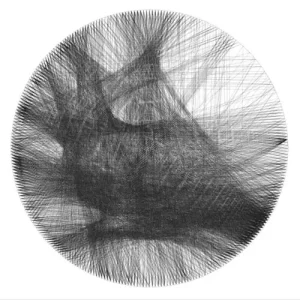
String Art Generator
String Art Generator by Yiran is a grasshopper plugin which generates a string art sequence based on an input image. You can
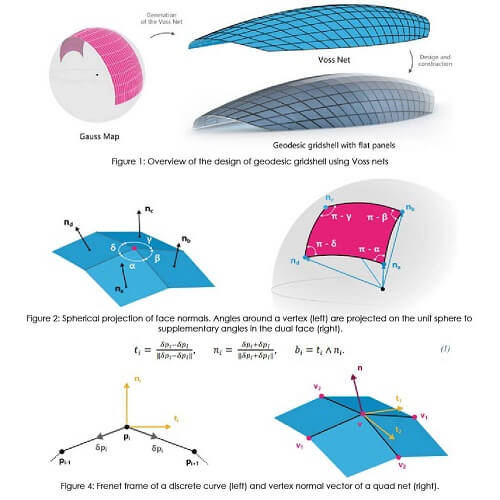
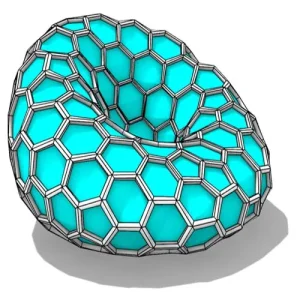
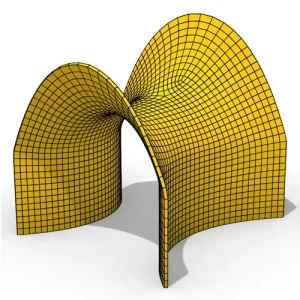
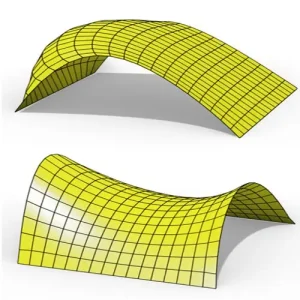
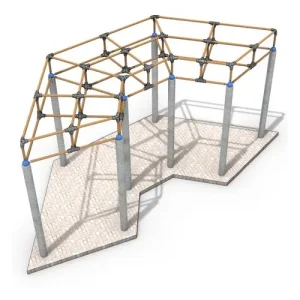
Voss surfaces: A design space for geodesic gridshells
The design of envelopes with complex geometries often leads to construction challenges. To overcome these difficulties, resorting to discrete differential geometry proved successful by establishing close links between mesh properties and the existence of good fabrication, assembling and mechanical properties.
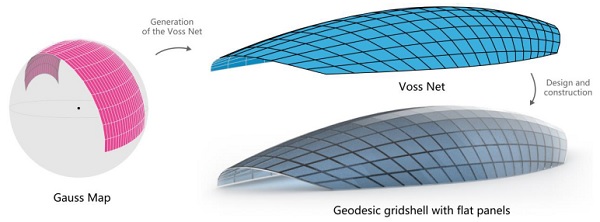
In this paper, the design of a special family of structures, called geodesic shells, is addressed using Voss nets, a family of discrete surfaces. The use of discrete Voss surfaces ensures that the structure can be built from simply connected, initially straight laths, and covered with flat panels.
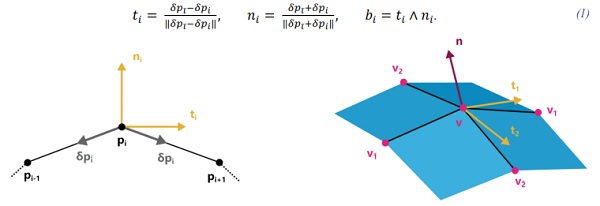
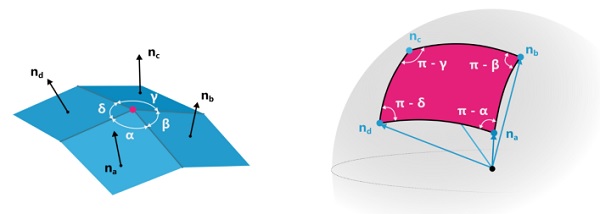
These advantageous constructive properties arise from the existence of a conjugate network of geodesic curves on the underlying smooth surface. Here, a review of Voss nets is presented and particular attention is given to the projection of normal vectors on the unit sphere.
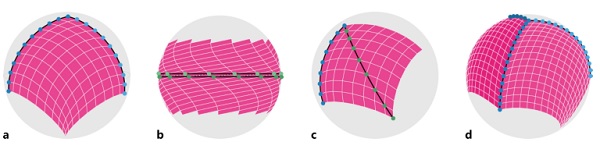
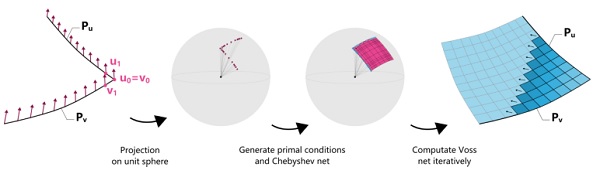
This projection, called Gauss map, creates a dual net which unveils the remarkable characteristics of Voss nets. Then, based on the previous study, two generation methods are introduced.
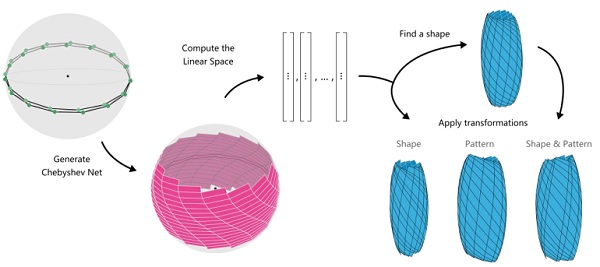
One enables the exploration and the deformation of Voss nets while the second provides a more direct computational technique. The application of theses methodologies is discussed alongside formal examples.
The construction of complex shaped envelopes gives rise to great challenges in terms of manufacturing and assembling. The design of the support structure must conciliate competing requirements, ranging from mechanical efficiency, through architectural intents, to cost effectiveness.
Two approaches coexist for the construction of complex shaped envelopes. Adopting the traditional way of building, the first one relies on stiff elements assembled with rigid connections (Schlaich and Schober, Mesnil et al., Tellier et al.) while the other strategy uses slender beams bent elastically.
The later type of structure, referred to as active-bending structures (Lienhard et al.), presents the benefit to smoothly approximate the target geometry.
In the great majority of cases, rectangular cross section beams are applied tangent to the surface (Harris et al., Liddell, Colabella et al.). However, in such structures, the arrangement of the members often results in excessive stresses and the covering requires the use of tailor-made doubly-curved elements.
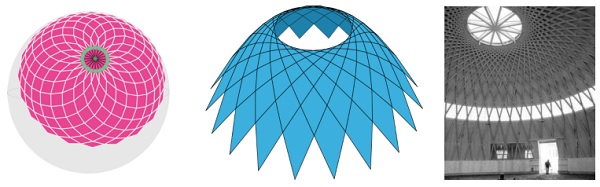
The problem of designing shells with actively bent rectangular elements was tackled by Natterer et al. who made use of geodesic lines. Geodesic lines are curves on surfaces with a vanishing geodesic curvature.
Hence, a lath following a geodesic line is not bent sideways, along its strong axis and avoids excessive stresses and local instabilities.
Inspired by Natterer et al., Pirazzi and Weinand proposed a framework for the design of shells with geodesic lines, called geodesic shells, and applied it for the realization of a pavilion.
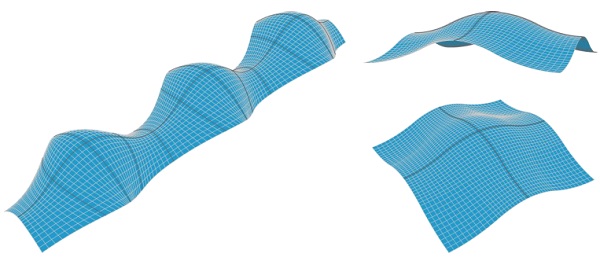
Recently, discrete differential geometry, appeared as an elegant and powerful way to address the challenges faced during the design of complex shapes. The constructive expectations are translated as geometrical constraints on the mesh, mesh which is a discrete representation of the doubly-curved envelope.
Using this point of view, geodesic lines were further studied for the mapping of surfaces (Pottmann et al.) or for the modelling of developable surfaces (Rabinovitch et al.). In this context, Douthe et al. presented a strategy for the covering of elastic gridshells with flat panels based on isoradial meshes.
The covering property results from the duality of the grid structure, called a Chebyshev net, with a conjugate network of curves. However, the problem of covering geodesic shell with flat quad was not addressed in the literature.
String Art Generator by Yiran is a grasshopper plugin which generates a string art sequence based on an input image. You can

This paper by Alessandro Liuti, Sofia Colabella, and Alberto Pugnale, presents the construction of Airshell, a small timber gridshell prototype erected by employing a pneumatic formwork.

In this paper by Gregory Charles Quinn, Chris J K Williams, and Christoph Gengnagel, a detailed comparison is carried out between established as well as novel erection methods for strained grid shells by means of FE simulations and a 3D-scanned scaled physical model in order to evaluate key performance criteria such as bending stresses during erection and the distance between shell nodes and their spatial target geometry.

In this paper by Frederic Tayeb, Olivier Baverel, Jean-François Caron, Lionel du Peloux, ductility aspects of a light-weight composite gridshell are developed.