Active Bending

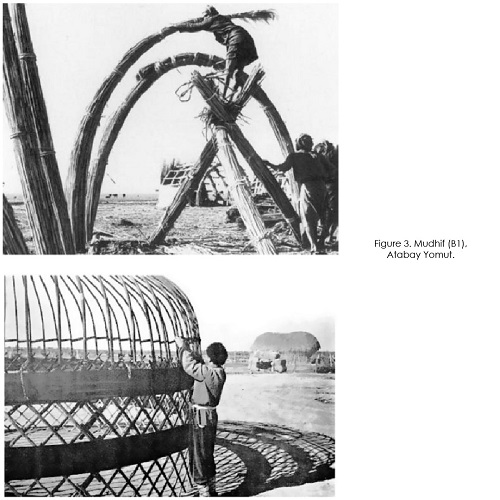
In this paper structures that actively use bending as a self-forming process are reviewed. By bringing together important material developments and various historical as well as recently built samples of such structures, the aim is to show coherences in their design approach, structural systems and behavior.

Continue reading

Timber Gridshells

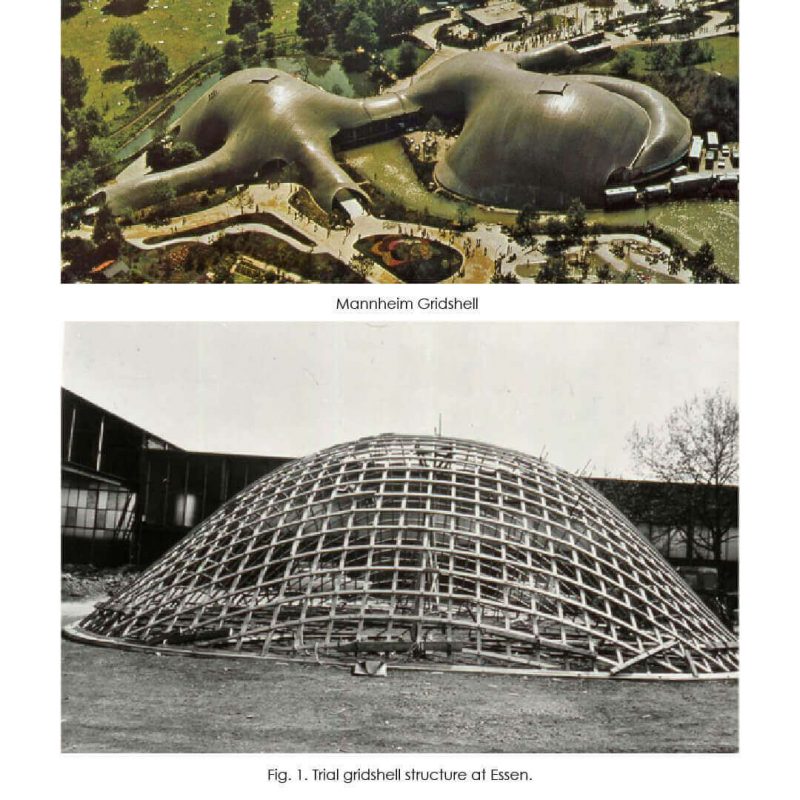
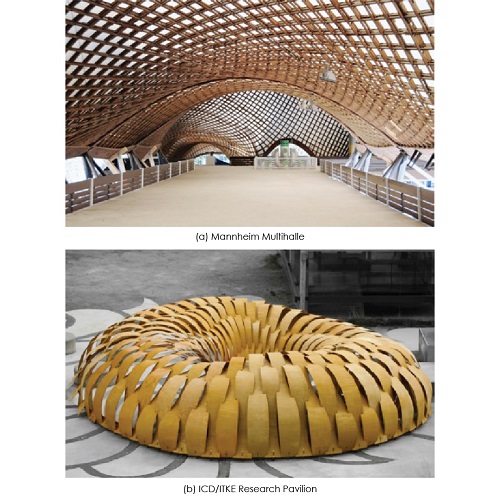
This paper describes timber gridshell design methods and building techniques. The authors’ experience with such projects is used to highlight the advantages of timber gridshells. Relevant built examples are presented and their formfinding and analysis methods are discussed.

Continue reading

Actively Bent Grid Shells

In this paper, a ‘facilitating’ numerical framework is introduced in which, for a given continuous reference shape, a geometrically similar discrete model is found by implementation of a six degree of freedom formulation of the Dynamic Relaxation method, to handle members bending and torsional stiffness.

Continue reading

Robotic Prefabrication

This thesis demonstrates the conception of the worldwide first double-story robotically assembled timber structure, explain its fabrication processes including an integrated envelope, and conclude by analyzing the robotic fabrication technologies in terms of their efficiency and structural and functional capabilities and limits.

Continue reading

Bespoke Timber Frame

This paper presents methods and techniques to robotically prefabricate timber frame modules. The key challenge of this research lies in enabling the digitally informed and fabricated spatial assembly of timber beams into prefabricated timber frame modules.

Continue reading

Timber Voronoi Shells

This paper introduces a variant of the timber grid shell, the timber Voronoi shell, whose surface is reticulated by Voronoi tessellation and whose edges are made of discrete dimensional timber. This work explores form-finding methods of the Voronoi shell as a compressive funicular shell.

Continue reading

Wooden Pavilion Gridshell

In the article two interacting aspects of collaborative design are described: shaping of the form and the rational use of materials. Form shaping will be analyzed on the basis of pavilions. The material aspect of this paper is concerned with the use of wood in contemporary construction.

Continue reading

Geodesic Gridshells

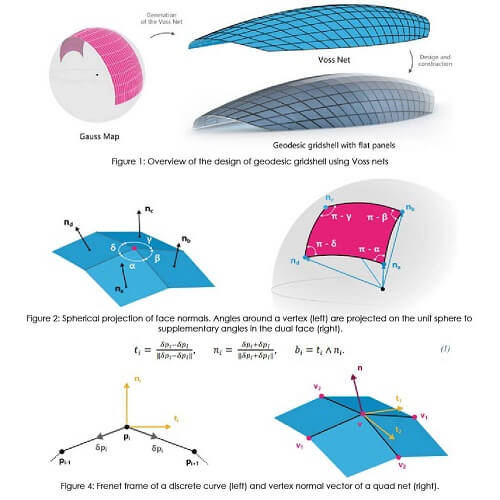
Voss nets constitute a proficient family of surfaces for the conception of doubly-curved structures. In this paper, they have been addressed for their capacity to model surfaces which can be built from elastically bent rectangular laths and covered with flat panels.

Continue reading

4D Printing Technology

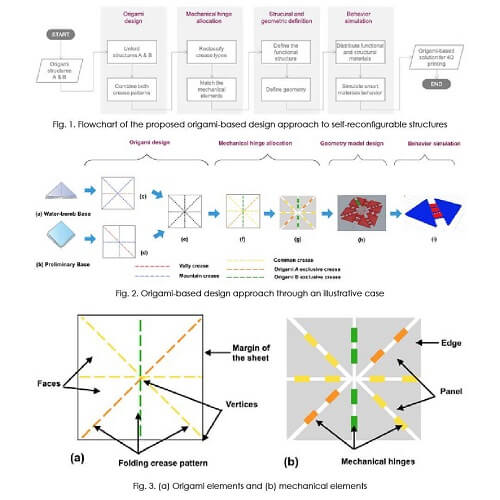
This paper proposes a new method based on smart materials and 4D printing technology to design and fabricate more compact structures that can realize self-reconfiguration via environmental stimulus without the need to alter sub-structures or components.

Continue reading