Lightweight Pavilion
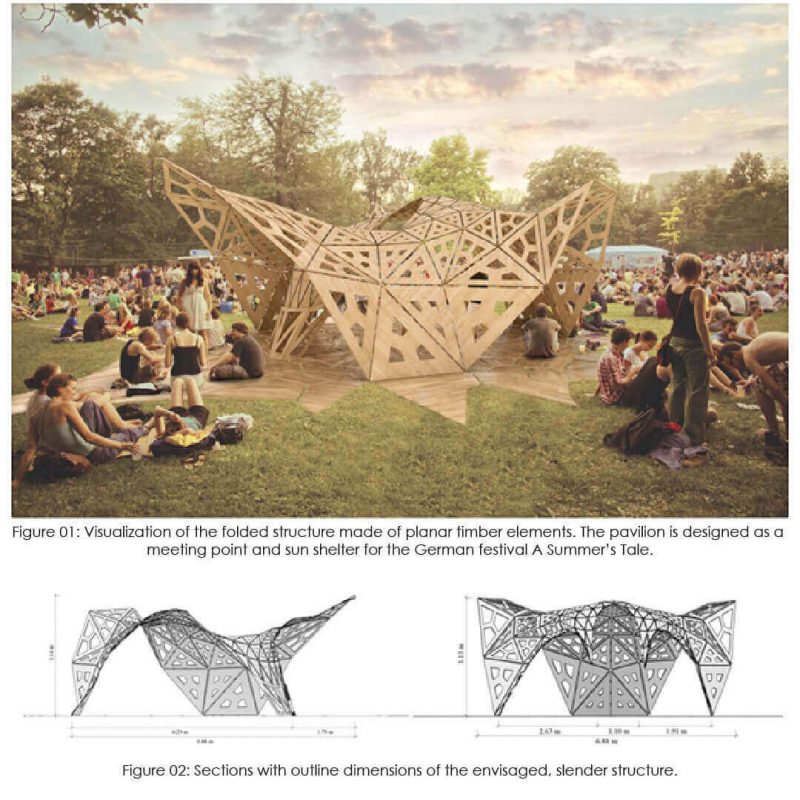
This paper by Maren Zywietz, Karsten Schlesier, and Annette Bögle, documents the approach to rethinking lightweight structures to face the growing scarcity of resources.
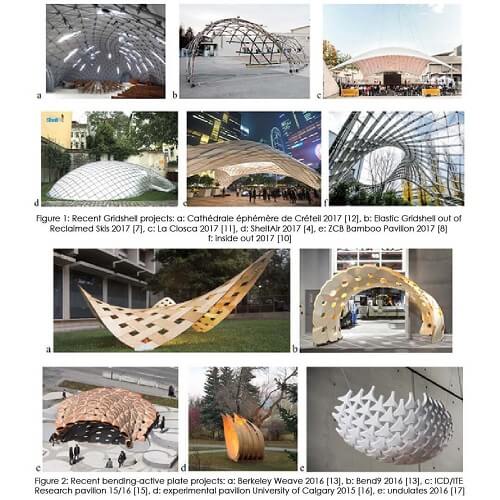
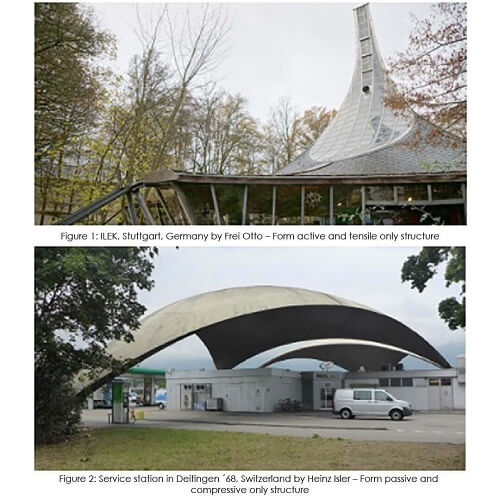
In this paper by Julian Lienhard, Christoph Gengnagel, many important historical examples of active-bending were gathered, dating back as far as early Mesopotamian dwellings up to the comparatively few contemporary examples of bending-active structures existing at that moment.
In this paper by William Boley, Wim M. van Rees, Charles Lissandrello, Mark N. Horenstein, Ryan L. Truby, Arda Kotikian, Jennifer A. Lewis, and L. Mahadevan, they exploit a combination of multiple materials, geometry, and 4-dimensional (4D) printing to create structured heterogeneous lattices that overcome this problem.
This paper by Tiffany Cheng, Dylan Wood, and Xiang Wang, presents an integrative approach to adaptive structures, which harnesses the scale and strength of natural material actuators such as wood as well as the functional physical programming of material properties enabled by 3D-printing.
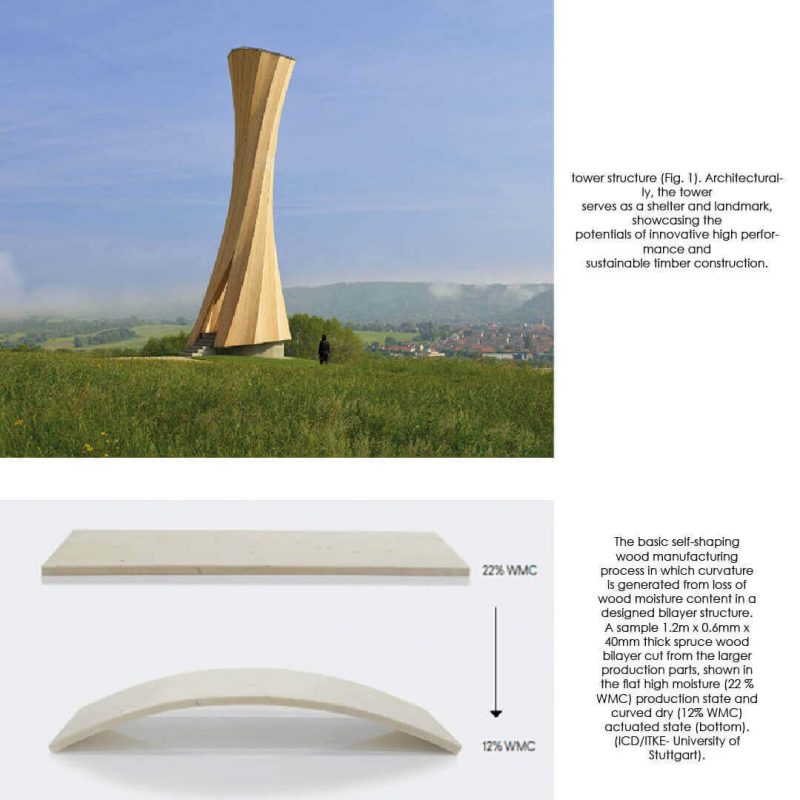
This research by Dylan Wood, Philippe Grȍnquist, Simon Bechert, Lotte Aldinger, David Riggenbach, Katharina Lehmann, Markus Rȕggeberg, Ingo Burgert, Jan Knippers, and Achim Menges, presents a paradigm shift towards a material-driven self-shaping fabrication method for full scale timber building components.
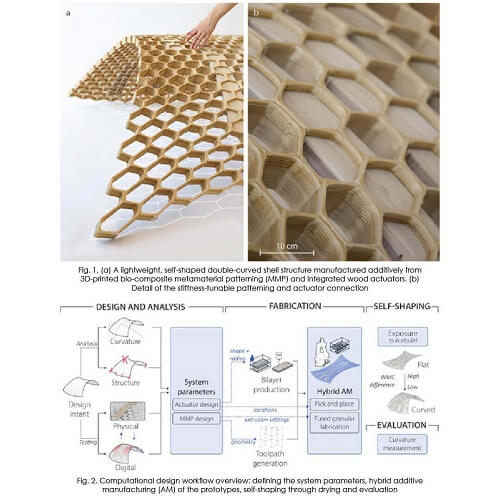
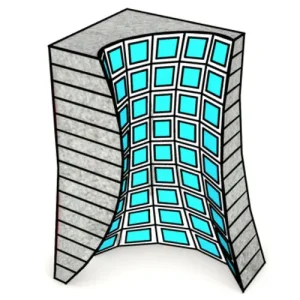
This research by E. Özdemir, L. Kiesewetter, K. Antorveza, T. Cheng, S. Leder, D. Wood, and A. Menges, presents a fabrication approach for self-shaping double-curved shell structures combining the hygroscopic shape-changing and scalability of wood actuators with the tunability of 3D-printed metamaterial patterning.
The Karamba plug-in developed by Clemens Preisinger in collaboration with Bollinger + Grohmann Engineers has been developed to predict the behaviour of structures under external loads.
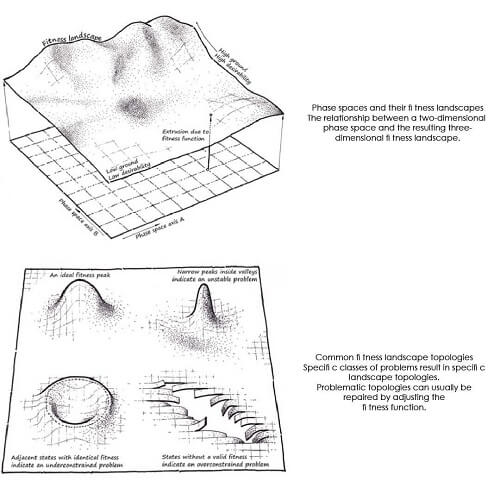
This article by David Rutten, discusses the parallels between phase space topologies and computational terminology as well as how generic solvers arrive at their solutions.
This article by Francesca Bertacchini, Eleonora Bilotta, Francesco Demarco, Pietro Pantano, and Carmelo Scuro, is based on the implementation of an integrated manufacturing system that involves parametric modeling, optimization, and additive manufacturing.
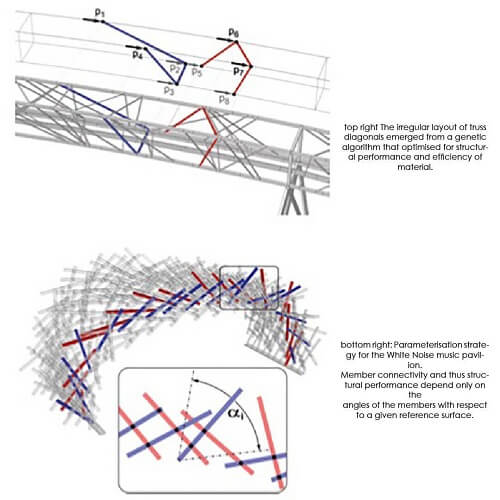
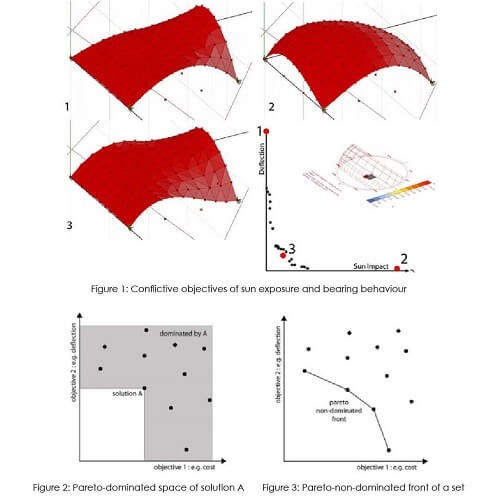
This paper by Francesco Demarco, Francesca Bertacchini, Carmelo Scuro, Eleonora Bilotta, and Pietro Pantano, is presented an optimization workflow that adopt a Multi Objective Optimization engine so called “Octopus” and Karamba3D, that is a Finite Elements (FE) plug-in, typically used in structural simulations, these extensions run in a software: Grassopper3D, that is a parametric design tool.
The aim of the research project by Robert Vierlinger, Arne Hofmann, is the development of a flexible generation and optimization framework for practical use in the sense of a continuously accompanying design explorer, in which parameterization is adaptable and objective functions are changeable at any time during the design process.
The research by Aleksander P. Otovic, Lotte M. B. Jensen, and Kristoffer Negendahl, has showed that the greatest effect in relation to achieving net-zero-energy buildings is achieved when indoor climate and energy simulation tools are applied from the very first architectural sketches, where geometry, façade design, orientation, etc.
This paper by Diego Apellániz, Panu Pasanen, Christoph Gengnagel, presents an approach for implementing life-cycle assessment (LCA) in the early design stages of a building project based on the new plugins for Rhino and Grasshopper of One Click LCA, which aims to contribute to fight climate change from within the construction industry.
This thesis by Jonathan Byrne, Philip Cardiff, Anthony Brabazon and Michael O’Neill, describes Traditional CAD tools that generate a static solution to a design problem. Parametric systems allow the user to explore many variations on that design theme.
This issue by Helen Castle, explores morphogenesis pertains that not only to the development of form and structure in an organism, but also to an organism’s evolutionary development over time.
This paper by Krystyna Januszkiewicz, Marta Banachowicz, explores the possibilities of using Structural Optimization Tools (ESO) digital tools in an integrated structural and architectural design in response to the current needs geared towards sustainability, combining ecological and economic efficiency.
This paper by Klaus Bollinger, Professor Manfred Grohmann and Oliver Tessmann, challanges the classification of structures according to defined building typologies that was central to engineering design.
This paper by Manfred GROHMANN, Philipp EISENBACH, Moritz RUMPF, Cynthia WARD, describes Lightweight and dismountable structures that are valuable examples in future building industry.
This paper by Philipp Eisenbach and Manfred Grohmann, describes lightweight concrete structures and structurally optimized systems.
This paper by Ragunath Vasudevan, Till Schneider, Kai Otto, Klaus Bollinger, Andreas Rutschmann, describes our integrated parallel approach to optimizing structures, using generative computational modelling systems, working alongside our clients, structural engineers and construction companies.